Who owns the code Claude Code wrote?
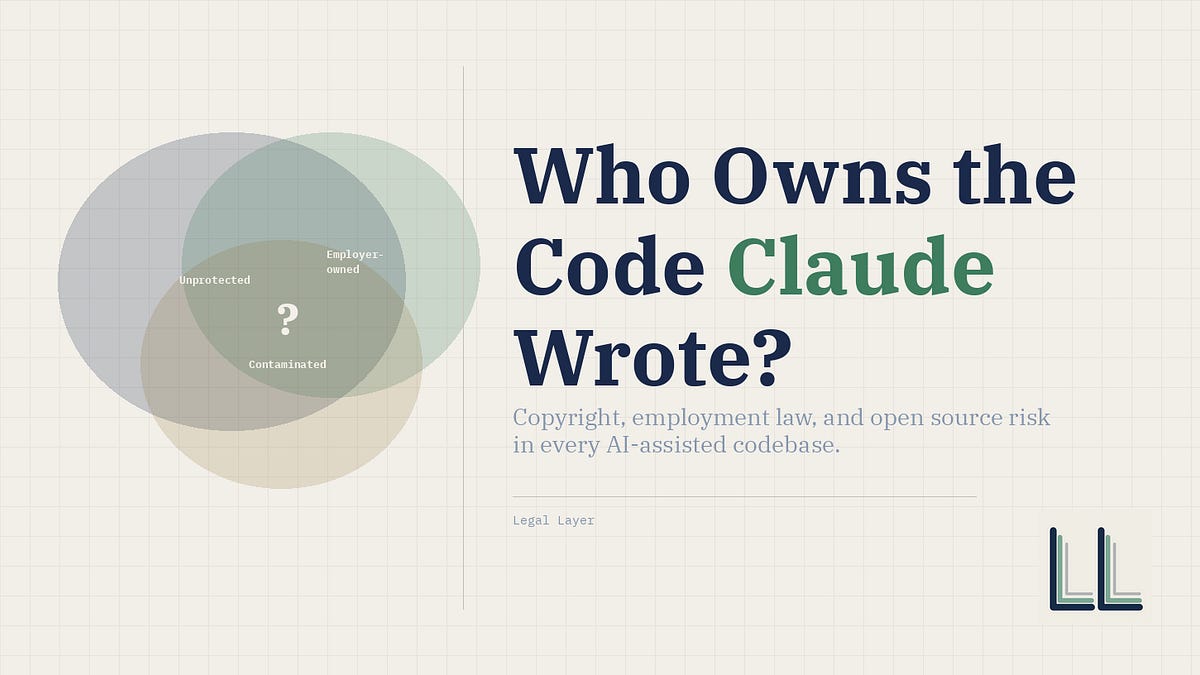
AI-generated code copyright explained for builders.
Full article excerpt tap to expand
Who Owns the Code Claude Wrote?AI-generated code copyright explained for builders.Sena EvrenApr 28, 20261ShareTL; DRAgentic coding tools such as Claude Code enable humans to direct agents in multi-step planning and execution on complex coding tasks. Copyright generally does not protect purely AI-generated material. Copyright can protect original human-created expression within a work even if the work also includes some AI-generated material. The key is documenting creative human contributions throughout the software development lifecycle.If you are using Claude Code, Codex, Cursor, etc. and you do not know whether the code you are shipping is copyrightable, whether you own it, or whether your employer owns it, this one is for you.Legal Layer Angle: In this piece I will talk about what a developer using AI coding tools needs to document to own what they build, what their employment contract probably says about AI-assisted work product, and what the practical implication is for open source contributions written with AI assistance.If you shipped code this week, some of it was probably written by an AI. The question of who legally owns that code is less settled than most developers assume, and the answer depends on three things that have nothing to do with how good the code is: whether a human made enough creative decisions to establish copyright,whether your employment contract already assigned it to your employer, and whether the model pulled from GPL-licensed training data and quietly contaminated your codebase.On March 31, 2026, Anthropic accidentally published 512,000 lines of Claude Code’s source code in a routine software update through a missing configuration file. Before sunrise, the codebase was mirrored across GitHub. Before breakfast, a developer had used an AI tool to rewrite the entire thing in Python, and the “claw-code” repository hit 100,000 GitHub stars in a single day, the fastest in history. Then came the DMCA takedowns, and then came the question nobody had a clean answer to: If Claude Code was, by Anthropic’s own lead engineer’s admission, predominantly written by Claude itself, does Anthropic even own it? Can you issue a DMCA takedown for code that copyright law may not protect?That incident compressed every open question about AI-generated code ownership into a single news cycle. The same questions apply to your codebase.The copyright rule nobody told youHere is the legal baseline, in plain terms: copyright only protects work created by a human. The US Copyright Office confirmed this in January 2025, and the Supreme Court declined to disturb it in March 2026 when it turned away the Thaler appeal. Works predominantly generated by AI without meaningful human authorship are not eligible for copyright protection, and that rule is now settled at the highest judicial level available.What it means for you: Code that Claude Code or Cursor generated and you accepted without meaningful modification may not be copyrightable by anyone. If a competitor copies it, you may have no legal recourse, because the code sits in the public domain in everything but name.The phrase that determines whether your code is protected is “meaningful human authorship,” and the Copyright Office has deliberately refused to quantify it with a percentage or a number of edits, because what courts look for is evidence that a human made genuine creative decisions: choosing the architecture, deciding what to reject, restructuring the output to fit a…
This excerpt is published under fair use for community discussion. Read the full article at Substack.
Discussion
0 commentsMore from Substack