What If the Universe Had No Beginning? Part 1: A Wave Function for the Universe
The article explores the challenge of understanding the universe's origin due to the breakdown of physical laws at the singularity. It introduces Stephen Hawking's radical proposal that the universe had no beginning in the conventional sense. The discussion traces back to John Wheeler and Bryce DeWitt's work in the 1960s to apply quantum mechanics to the entire universe.
- ▪The equations of general relativity break down at the singularity, making it impossible to determine the universe's initial conditions.
- ▪Stephen Hawking proposed that the universe had no beginning, suggesting the question itself may be meaningless.
- ▪John Wheeler and Bryce DeWitt developed the Wheeler-DeWitt equation, which applies quantum mechanics to the entire universe by treating it as a quantum object.
- ▪The approach involves promoting elements of general relativity to quantum operators, leading to a wave function for the universe.
- ▪This framework allows for multiple possible descriptions of the universe, similar to how quantum mechanics describes particles like electrons.
Opening excerpt (first ~120 words) tap to expand
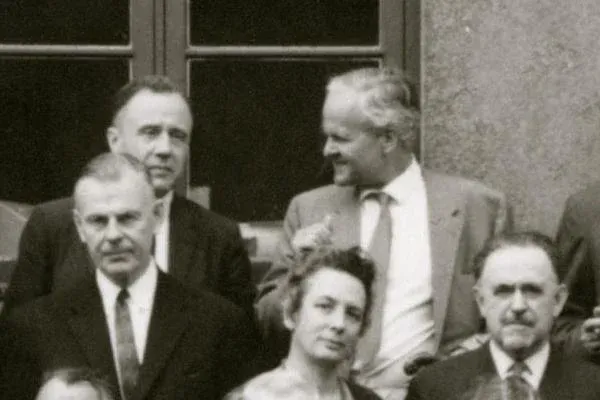
What If the Universe Had No Beginning? Part 1: A Wave Function for the Universe By Paul Sutter - May 16, 2026 02:08 PM UTC | Physics John Wheeler (right) with Carl Friedrich von Weizsäcker, Bengt Strömgren, and Stefan Rozental in 1963. Wheeler co-developed the equation that treats the entire universe as a quantum object. (Public domain, Niels Bohr Library & Archives) All you need to do to figure out the mystery of the beginning of the universe is to take your general theory of relativity and run the clock backwards to see what happens, you know, at the beginning. Except you can't. You can't because of one eensy teensy little problem, and that's the problem of the SINGULARITY.
…
Excerpt limited to ~120 words for fair-use compliance. The full article is at Universe Today.