First-of-its-kind map of the mouse nose reveals surprises about the sense of smell
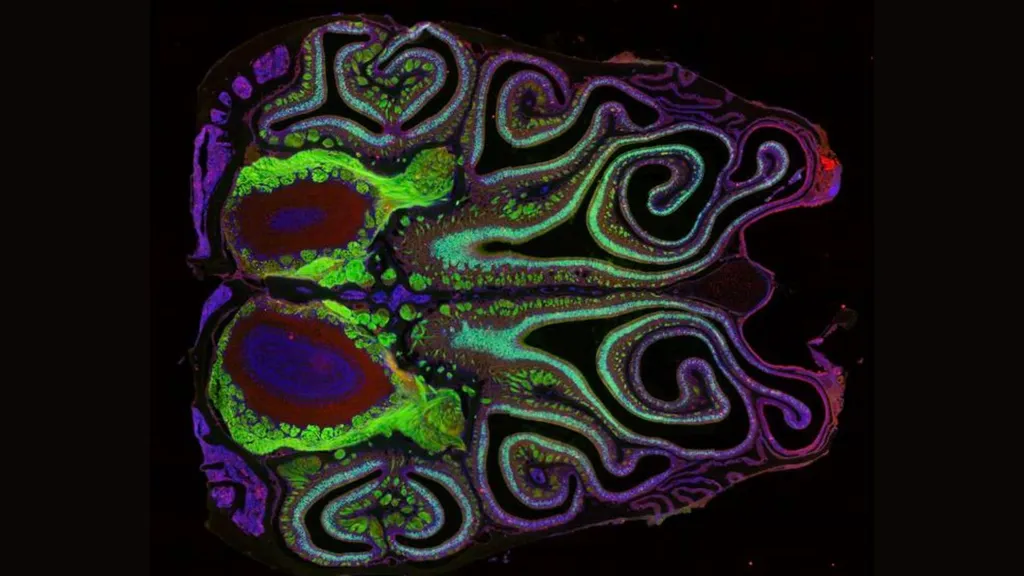
Scientists have created the first comprehensive map of smell receptors in the mouse nose, revealing that these receptors are organized into precise, banded patterns rather than being randomly distributed. This spatial organization challenges previous assumptions about how the sense of smell functions. The findings provide new insights into olfactory biology using advanced techniques like single-cell sequencing and spatial transcriptomics.
- ▪Smell receptors in the mouse nose are organized into over 1,000 tightly defined bands, contrary to earlier beliefs of random distribution.
- ▪Each olfactory sensory neuron expresses one of 1,172 different receptors, each tuned to detect specific odor types.
- ▪Advanced techniques such as single-cell sequencing and spatial transcriptomics enabled researchers to map receptor expression with high precision.
- ▪The study was published on April 28, 2026, in the journal Cell, led by neurobiologist Dr. Sandeep Datta of Harvard Medical School.
Opening excerpt (first ~120 words) tap to expand
Health Neuroscience First-of-its-kind map of the mouse nose reveals surprises about the sense of smell A new map shows how smell receptors in the mouse nose are precisely organized into tight bands based on type. By Payal Dhar published 28 April 2026 in News When you purchase through links on our site, we may earn an affiliate commission. Here’s how it works. This microscope photo of a cross section of a mouse nose shows scent-sensing neurons in green, as well as dying neurons in red.
…
Excerpt limited to ~120 words for fair-use compliance. The full article is at Live Science.
Discussion
0 commentsMore from Live Science