1,900-year-old souvenir cup featuring Hadrian's Wall and Roman forts discovered in Spain
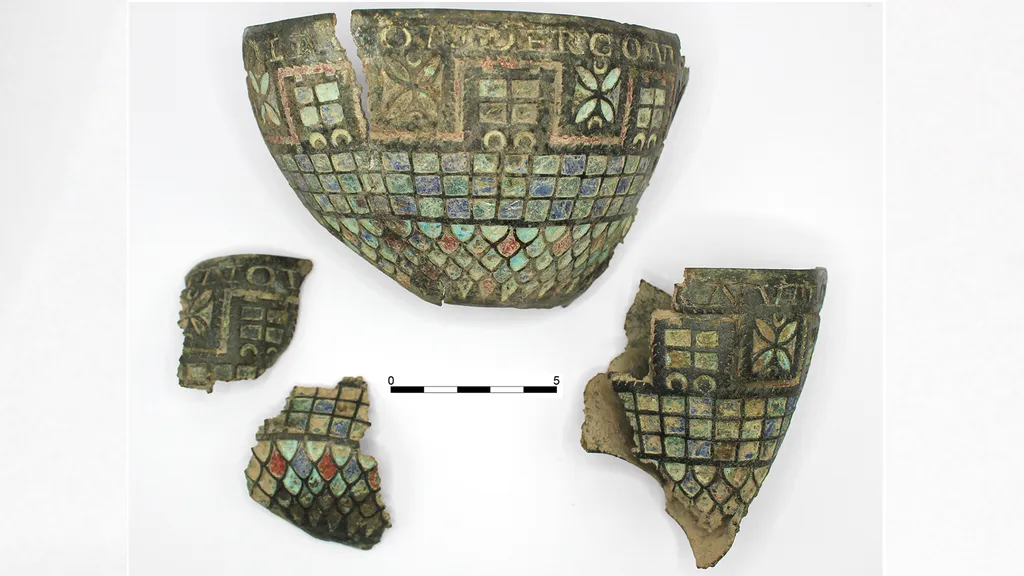
A 1,900-year-old bronze cup depicting Hadrian's Wall and Roman forts was discovered in Berlanga de Duero, Spain. The cup, likely a memento for a soldier stationed in northern England, features enameled designs and a Latin inscription naming four forts. Researchers believe it was crafted near Hadrian's Wall between A.D. 124 and 199 before ending up in Spain.
- ▪The Berlanga Cup is a hemispheric bronze vessel about 4.5 inches wide and 3.2 inches tall with colorful enamel designs.
- ▪It bears a Latin inscription referencing four forts on the eastern side of Hadrian's Wall: Cilurnum, Onno, Vindobala, and Condercom.
- ▪Analysis shows the cup was made from bronze with lead likely sourced from northern England, indicating local production near Hadrian's Wall.
- ▪The cup may have been brought to Spain by a soldier from the Cohors I Celtiberorum, a Roman auxiliary unit of Hispanic origin stationed at the wall.
- ▪Archaeologists used 3D scanning to reconstruct the cup from four fragments found in central Spain.
Opening excerpt (first ~120 words) tap to expand
Archaeology Romans 1,900-year-old souvenir cup featuring Hadrian's Wall and Roman forts discovered in Spain Archaeologists think a broken bronze cup found in Spain was made for a soldier as a memento of his time stationed at Hadrian's Wall in England. By Kristina Killgrove published 28 April 2026 in News When you purchase through links on our site, we may earn an affiliate commission. Here’s how it works. The Berlanga Cup was found in four pieces. (Image credit: Roberto De Pablo) Copy link Facebook X Reddit Pinterest Flipboard Share this article 2 Join the conversation Follow us Add us as a preferred source on Google Newsletter Subscribe to our newsletter A chance discovery of a broken bronze cup in Spain has revealed a 1,900-year-old depiction of Hadrian's Wall and forts in England, a…
Excerpt limited to ~120 words for fair-use compliance. The full article is at Live Science.
Discussion
0 commentsMore from Live Science