The effect of sleep on blood biomarkers
A recent analysis examined the relationship between sleep and blood biomarkers using data from over 7,000 individuals. The study found significant correlations between sleep quality, duration, and various blood markers, particularly in immune cell ratios and glucose levels. While the findings suggest that better sleep is associated with improved health metrics, the study emphasizes that these correlations do not imply causation.
- ▪The analysis included 7,033 paired observations from individuals tracking their sleep and ordering blood tests.
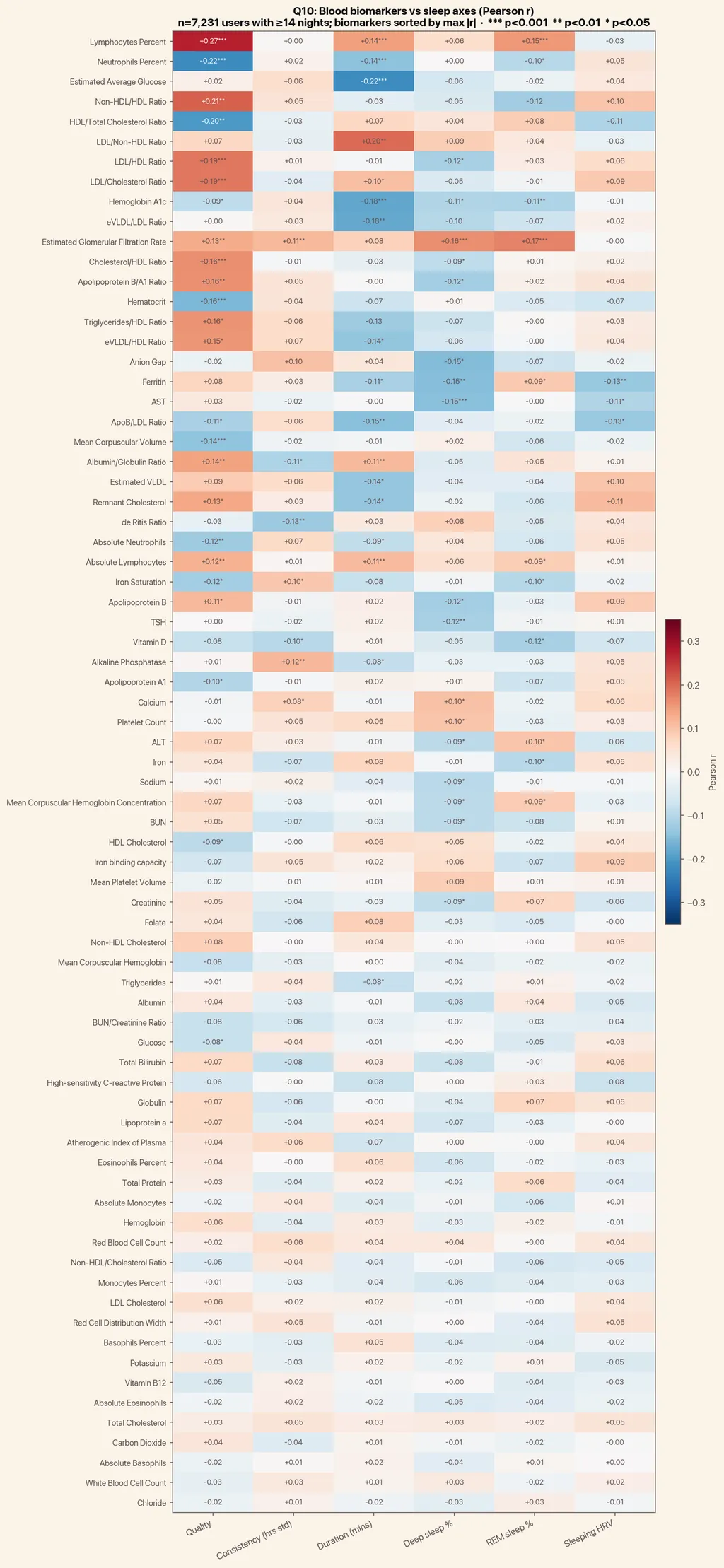
- ▪Out of 444 biomarker and sleep metric pairings, 79 showed statistically significant correlations.
- ▪The strongest correlations were found between sleep quality and immune cell ratios, as well as sleep duration and blood sugar levels.
Opening excerpt (first ~120 words) tap to expand
The effect of sleep on blood biomarkers Brandon Ballinger May 4, 2026 When patients ask us “what does sleep actually change in my blood?”, the honest answer is that very few studies look at it directly. Most sleep research ties bad nights to disease outcomes (heart attacks, dementia, mortality), not to the panels your annual labs measure. So we ran the analysis ourselves. We pulled 7,033 paired observations from Empirical Health members who track sleep on Apple Watch or other wearables and who have ordered a blood test. Each pair lined up a biomarker result with the average of at least 18 nights of sleep data leading up to the draw. Across 444 biomarker × sleep-metric pairings, 79 reached p<0.05 and 15 reached p<0.001.
…
Excerpt limited to ~120 words for fair-use compliance. The full article is at Empirical Health.
Discussion
0 commentsMore from Empirical Health