Recursive Language Models: An All-in-One Deep Dive
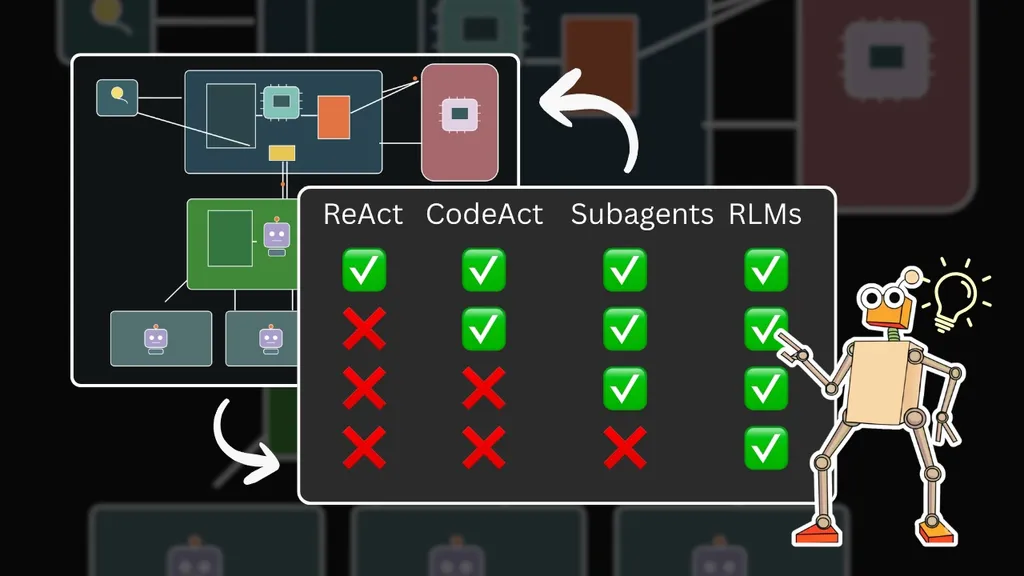
Recursive Language Models (RLMs) represent a new approach in agentic AI architectures that differ significantly from methods like ReAct and CodeAct by passing context by reference rather than replication. They excel in long-context benchmarks and handle complex, structured tasks more efficiently by avoiding redundant data processing. A simple fruit-naming and letter-counting task illustrates how RLMs manage context and computation more effectively than traditional models.
- ▪Recursive Language Models (RLMs) pass context by reference instead of replicating it, which improves efficiency in long-context tasks.
- ▪RLMs outperform models like ReAct and CodeAct in benchmarks that require handling extended or nested data structures.
- ▪Unlike ReAct, which relies on predefined tool functions for tasks like counting letters, RLMs can dynamically manage context and computation without external tool definitions.
- ▪The article uses a fruit, country, and animal naming task with letter counting to demonstrate how RLMs handle structured output generation more effectively.
- ▪Direct generation and ReAct methods struggle with accuracy and scalability in tasks requiring verification or nested outputs, whereas RLMs are designed to address these limitations.
Opening excerpt (first ~120 words) tap to expand
Large Language Models Recursive Language Models: An All-in-One Deep Dive Exactly how does it differ from ReAct, CodeAct, Self-Loops, and Subagents? Avishek Biswas May 16, 2026 33 min read Share In this article, you will learn what Recursive Language Models (RLMs) are, why they are winning all the long-context benchmarks right now, and understand how they are different from existing agentic harness designs! And we are going to learn it by magnifying one simple case study. I have spent a decent chunk of last month implementing RLMs, running benchmarks, and producing a 50-minute tutorial video on it. Throughout the process, I responded to 100+ questions on YouTube and X about RLMs.
…
Excerpt limited to ~120 words for fair-use compliance. The full article is at Towards Data Science.
Discussion
0 commentsMore from Towards Data Science