WeSearch

MIT scientists turn chaotic laser light into powerful brain imaging tool
·7 min read · 0 reactions · 0 comments · 9 views
MIT scientists turn chaotic laser light into powerful brain imaging tool

Scientists at MIT discovered that chaotic laser light can spontaneously form a highly focused beam instead of scattering—if the conditions are just right. This “pencil beam” enabled them to image the blood-brain barrier in 3D at speeds 25 times faster than existing techniques. The method also lets researchers watch how drugs move into brain cells in real time. It could dramatically accelerate the development of treatments for neurological diseases.

Original article
Science News
Read full at Science News →
Full article excerpt tap to expand

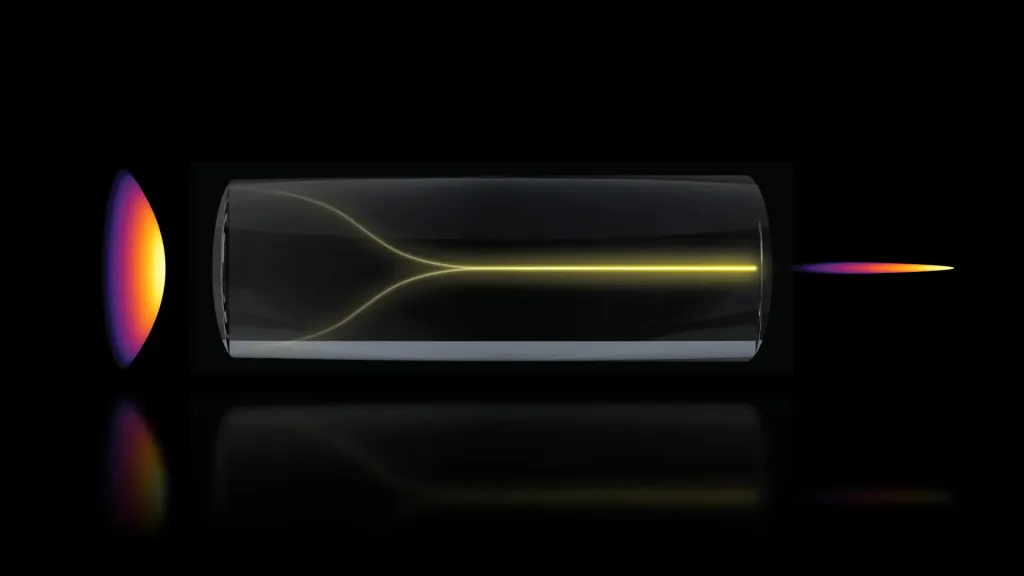
Science News from research organizations MIT scientists turn chaotic laser light into powerful brain imaging tool Chaotic laser light just learned a new trick—turning itself into a precision beam that could fast-track brain disease research. Date: April 28, 2026 Source: Massachusetts Institute of Technology Summary: Scientists at MIT discovered that chaotic laser light can spontaneously form a highly focused beam instead of scattering—if the conditions are just right. This “pencil beam” enabled them to image the blood-brain barrier in 3D at speeds 25 times faster than existing techniques. The method also lets researchers watch how drugs move into brain cells in real time. It could dramatically accelerate the development of treatments for neurological diseases. Share: Facebook Twitter Pinterest LinkedIN Email FULL STORY Under the right conditions, a chaotic mess of laser light can spontaneously self-organize into a highly focused “pencil beam.” This schematic shows the pencil beam formation mechanism. Credit: MIT Researchers at MIT have identified an unexpected effect in optical physics that could lead to a faster and more detailed way to image living tissue. Under specific conditions, what normally looks like a scattered and disordered laser signal can reorganize itself into a narrow, highly focused "pencil beam." With this self-formed beam, the team produced 3D images of the human blood-brain barrier at speeds about 25 times faster than the current gold-standard approach, while preserving similar image quality. The method also makes it possible to watch individual cells absorb drugs in real time. This could help scientists evaluate whether treatments for conditions such as Alzheimer's or ALS are actually reaching their intended targets in the brain. "The common belief in the field is that if you crank up the power in this type of laser, the light will inevitably become chaotic. But we proved that this is not the case. We followed the evidence, embraced the uncertainty, and found a way to let the light organize itself into a novel solution for bioimaging," says Sixian You, assistant professor in the MIT Department of Electrical Engineering and Computer Science (EECS), a member of the Research Laboratory for Electronics, and senior author of a paper on this imaging technique. She is joined on the paper by lead author Honghao Cao, an EECS graduate student; EECS graduate students Li-Yu Yu and Kunzan Liu; postdocs Sarah Spitz, Francesca Michela Pramotton, and Federico Presutti; Zhengyu Zhang PhD '24; Subhash Kulkarni, an assistant professor at Harvard University and the Beth Israel Deaconess Medical Center; and Roger Kamm, the Cecil and Ida Green Distinguished Professor of Biological and Mechanical Engineering at MIT. The paper appears today in Nature Methods. A Surprising Laser Behavior Emerges The finding began with an observation that did not fit expectations. The researchers had previously built a precise fiber shaper, a device that allows careful control of laser light traveling through a multimode optical fiber, which is capable of carrying high levels of power. Cao gradually increased the laser power to test the limits of the fiber. Normally, increasing power causes the light to scatter more due to imperfections inside the fiber. Instead, as the power approached the threshold where the fiber might be damaged, the light suddenly concentrated into a single, extremely sharp beam. "Disorder is intrinsic to these fibers. The light…

This excerpt is published under fair use for community discussion. Read the full article at Science News.

Anonymous · no account needed
Share 𝕏 Facebook Reddit LinkedIn Email

Discussion

0 comments

More from Science News