Lost in Translation: How AI Exposes the Rift Between Law and Logic
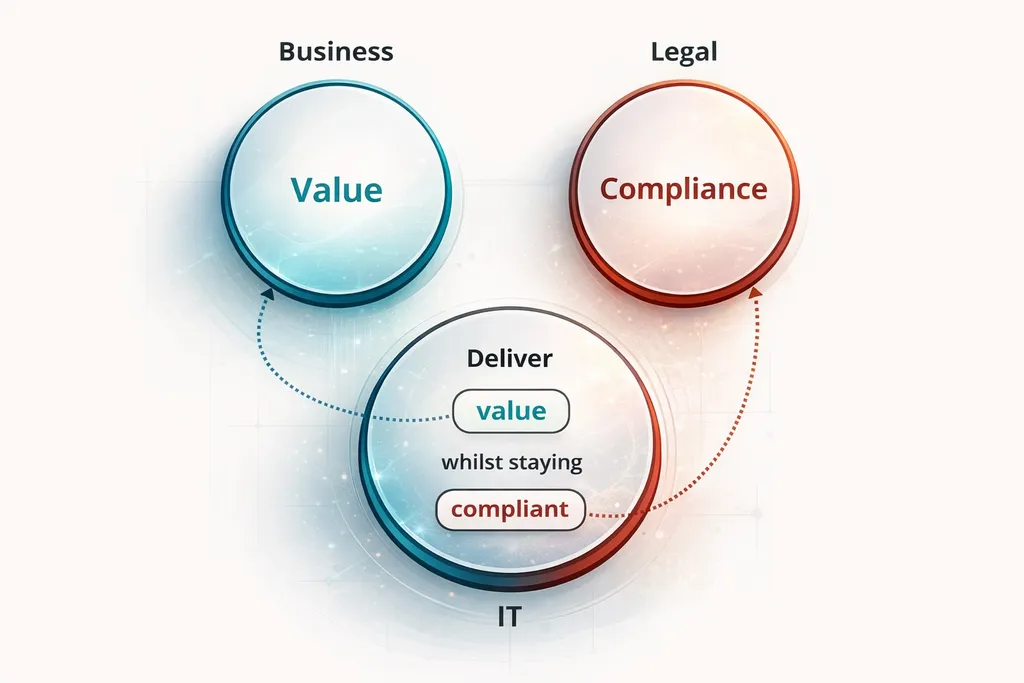
The article discusses the growing disconnect between legal and IT teams as AI technology advances. It highlights the challenges of aligning legal intent with IT requirements, especially in the context of compliance and data usage. The piece proposes a framework for translating legal principles into machine-readable formats to bridge this gap.
- ▪The tension between legal and IT teams has been exacerbated by the rise of AI and the introduction of GDPR rules.
- ▪Legal professionals operate with a focus on risk mitigation and defensibility, while IT requires specificity and deterministic controls.
- ▪The increasing volume and velocity of AI-driven data usage threaten traditional compliance models, making manual oversight impractical.
Opening excerpt (first ~120 words) tap to expand
Artificial Intelligence Lost in Translation: How AI Exposes the Rift Between Law and Logic The tension between Legal and IT has always been frustrating but AI is about to make it worse, at scale. The answer is observable compliance: encoding legal intent directly into architecture. Corné POTGIETER May 22, 2026 20 min read Share Image generated with ChatGPT Over the last few years, I have sat in multiple meetings with IT and legal teams where the intent and motivation is visibly misaligned. It often feels like two completely different worlds trying to reach agreement under pressure. As one colleague once described it to me: “Legal writes for humans, IT builds for machines.” Law allows interpretation, context, and mitigation, while IT depends on logic and deterministic workflows.
…
Excerpt limited to ~120 words for fair-use compliance. The full article is at Towards Data Science.
Discussion
0 commentsMore from Towards Data Science