Learning From Pairwise Preferences: An Introduction to the Bradley Terry Model
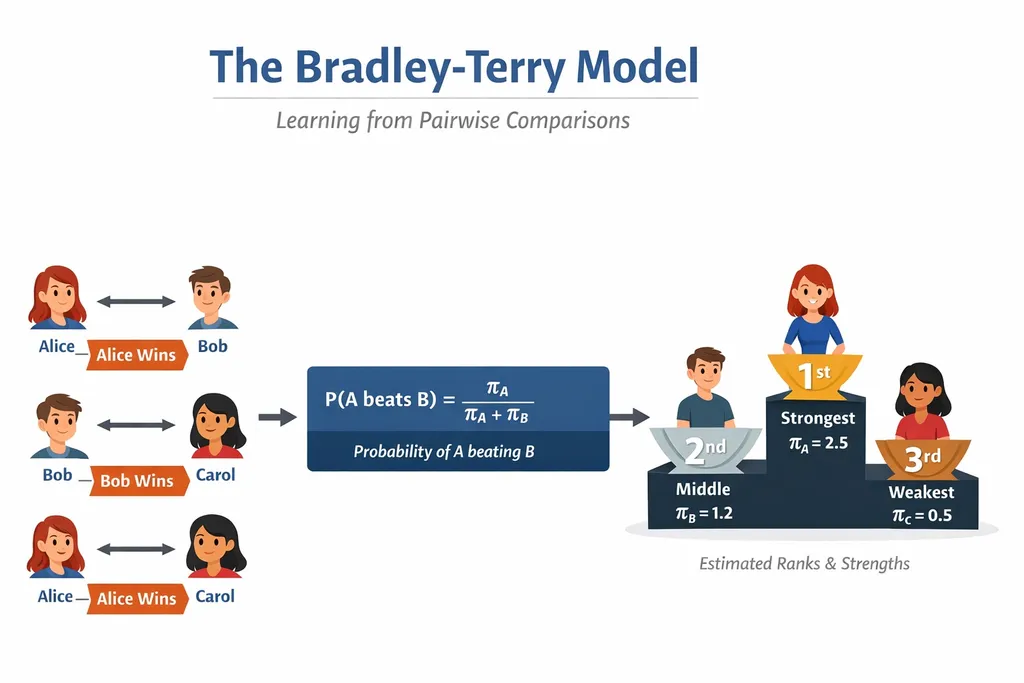
The Bradley-Terry model provides a framework for deriving probabilistic rankings from pairwise comparisons rather than absolute judgments. It operates on the principle that each item has a latent strength, which influences the likelihood of one item being preferred over another. This model is particularly useful in scenarios where direct scoring is difficult, allowing for a coherent ranking based on comparative preferences.
- ▪The Bradley-Terry model infers latent strengths from pairwise preferences to create probabilistic rankings.
- ▪It assumes each item has an unobserved positive strength parameter that determines its likelihood of being preferred over another item.
- ▪The model is closely related to logistic modeling, focusing on the relative differences in strengths rather than absolute scores.
Opening excerpt (first ~120 words) tap to expand
Machine Learning Learning From Pairwise Preferences: An Introduction to the Bradley Terry Model How to turn simple head-to-head choices Into probabilistic rankings Sean Moran May 27, 2026 28 min read Share Source: image by author via GPT-5.4. Much of statistical learning assumes the availability of absolute labels. For example, an instance belongs to a class, a document receives a score, an observation is assigned a probability, a product is rated on a fixed scale. In practice, however, human judgment often appears in a more local and comparative form. People may not know whether an answer deserves 7.4 out of 10, but they can often say which of two answers is better.
…
Excerpt limited to ~120 words for fair-use compliance. The full article is at Towards Data Science.
Discussion
0 commentsMore from Towards Data Science