First-ever direct image of the cosmic web reveals the Universe’s hidden highways
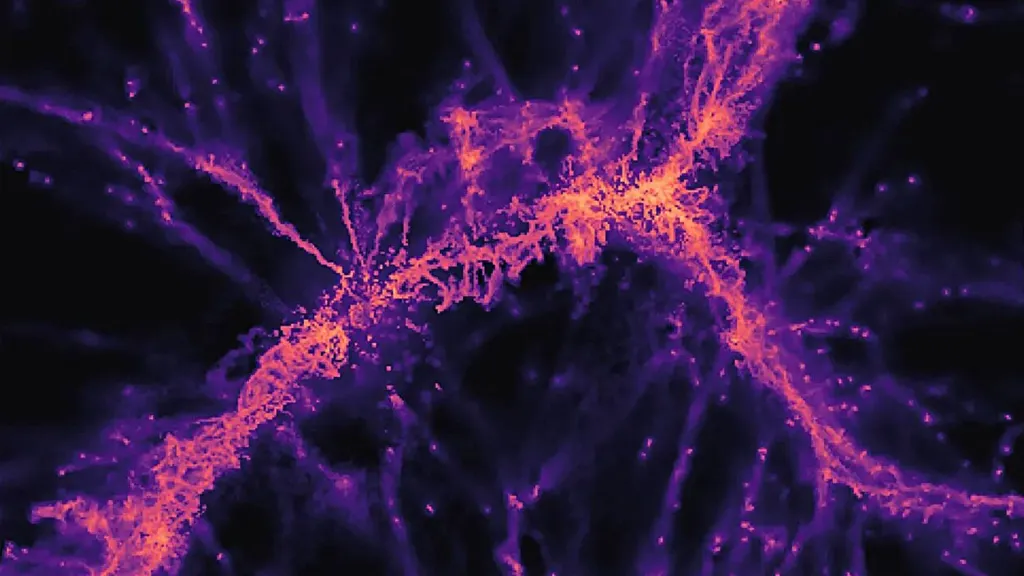
Astronomers have captured the sharpest image yet of a cosmic filament, a massive structure stretching 3 million light-years and connecting two galaxies from nearly 12 billion years ago. This direct observation of faint intergalactic gas provides new insights into how galaxies form and evolve through the flow of gas along the cosmic web. The findings, achieved using the MUSE instrument on the Very Large Telescope, align closely with supercomputer simulations of large-scale cosmic structure.
- ▪The observed cosmic filament connects two actively forming galaxies from when the Universe was about 2 billion years old.
- ▪Researchers used the MUSE instrument on the European Southern Observatory's Very Large Telescope in Chile for hundreds of hours to capture the faint glow of hydrogen gas.
- ▪The filament's light traveled nearly 12 billion years to reach Earth, allowing scientists to directly trace the boundary between galactic and intergalactic gas.
- ▪Supercomputer simulations from the Max Planck Institute for Astrophysics were used to compare and validate the observational data.
- ▪The study was published in Nature Astronomy and marks a major step in understanding how gas fuels galaxy formation across the cosmic web.
Opening excerpt (first ~120 words) tap to expand
Science News from research organizations First-ever direct image of the cosmic web reveals the Universe’s hidden highways Date: May 16, 2026 Source: Max Planck Institute for Astrophysics Summary: Astronomers have revealed the sharpest image ever captured of a filament in the cosmic web — the enormous hidden structure connecting galaxies across the Universe. The glowing strand stretches 3 million light-years and links two galaxies from nearly 12 billion years ago. By observing this faint intergalactic gas directly for the first time in such detail, scientists gained new insight into how galaxies are fueled and formed.
…
Excerpt limited to ~120 words for fair-use compliance. The full article is at ScienceDaily.
Discussion
0 commentsMore from ScienceDaily