Why the gradient is a list of partial derivatives
The article explores the concept of the gradient in multivariate calculus, highlighting its significance in determining the direction of steepest ascent. It explains how partial derivatives can be combined into a vector that indicates the fastest change in a function's value. The author emphasizes the intuitive nature of this mathematical concept through relatable examples, such as navigating a ski slope.
- ▪The gradient formula consists of partial derivatives that represent slopes in different directions.
- ▪By stacking partial derivatives into a vector, one can identify the direction of steepest ascent.
- ▪The article uses the analogy of skiing to illustrate how direction affects changes in height.
Opening excerpt (first ~120 words) tap to expand
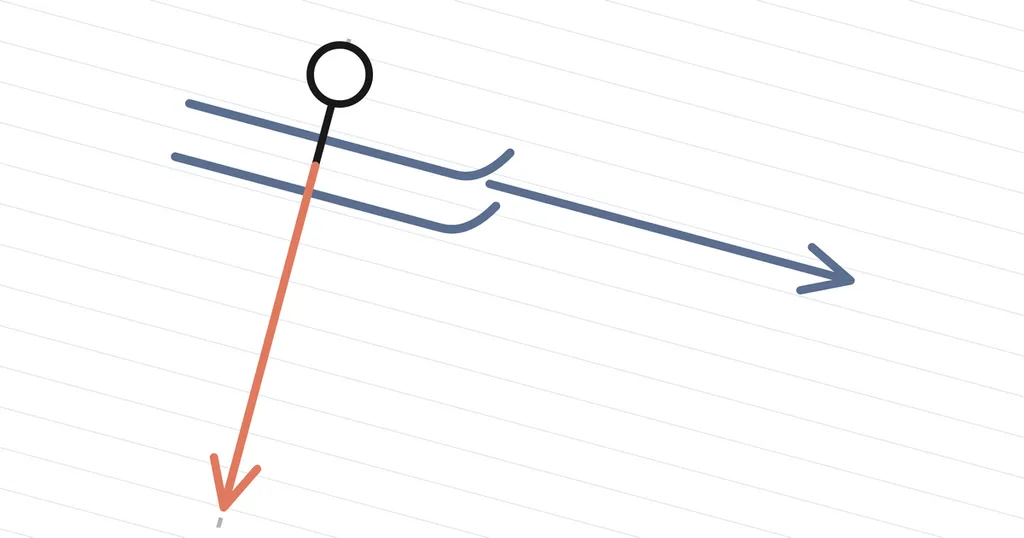
If there is one thing that keeps me awake at night, it is multivariate calculus. The gradient formula always struck me as suspicious in how plain it looks: ∇f=(∂f∂x, ∂f∂y)\nabla f = \left(\frac{\partial f}{\partial x},\ \frac{\partial f}{\partial y}\right)∇f=(∂x∂f, ∂y∂f) You could practically guess it. Partial derivatives are numbers, there is one per coordinate, so you stack them in a list and see what comes out. The thing that comes out happens to point in the direction of fastest change, with a length equal to that maximum rate. Run that recipe on a real landscape — the two hills below. The formula for their height fff is a bit of a mess, but the recipe only ever needs its two partial derivatives. You are here — the spot where we read the two slopes.
…
Excerpt limited to ~120 words for fair-use compliance. The full article is at Hacker News (Newest).
Discussion
0 commentsMore from Hacker News (Newest)