Why some water fleas suddenly grow helmets: Key receptors reveal how predator warnings trigger defense
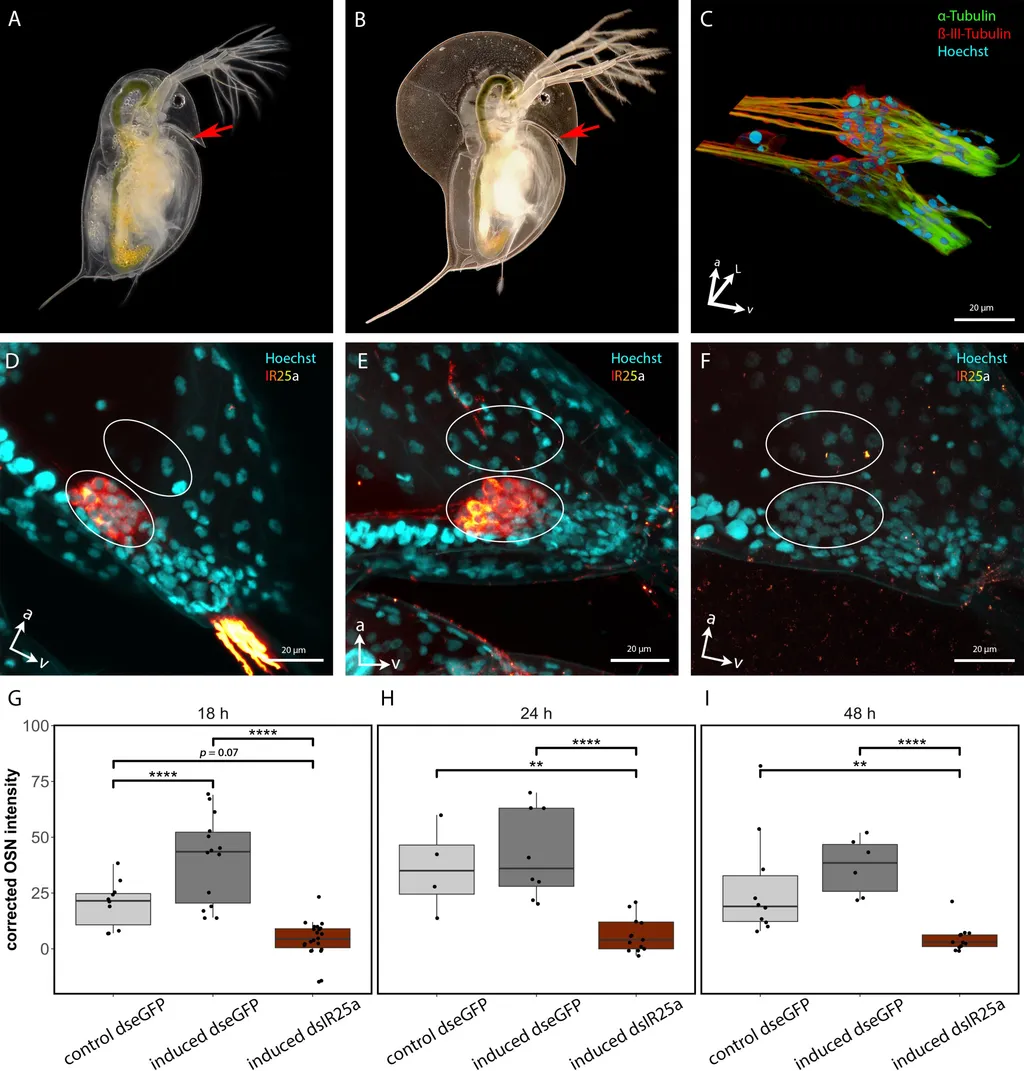
Water fleas, or Daphnia, can rapidly develop defensive physical traits like helmets and spines when they detect predators in their environment. Researchers at Ruhr-University Bochum have identified two key ionotropic receptors, IR25a and IR93a, that are essential for detecting chemical cues from predators. When these receptors are impaired, Daphnia fail to initiate defensive morphological changes, indicating their critical role in threat response.
- ▪Daphnia detect predators through chemical cues released into the water.
- ▪The ionotropic receptors IR25a and IR93a are crucial for forming functional chemosensory complexes in Daphnia antennules.
- ▪Gene knockdown experiments showed that reducing IR25a and IR93a expression prevents Daphnia from developing predator-induced defenses.
- ▪Different Daphnia species develop distinct physical defenses, such as helmets or spines, in response to specific predators.
- ▪The study was published in Proceedings of the Royal Society B: Biological Sciences and involved RNA interference techniques to investigate chemoreceptor function.
Opening excerpt (first ~120 words) tap to expand
May 16, 2026 feature Why some water fleas suddenly grow helmets: Key receptors reveal how predator warnings trigger defense by Ingrid Fadelli, Phys.org Ingrid Fadelli Author Meet our staff & contributors Learn about our editorial standards edited by Sadie Harley, reviewed by Robert Egan Sadie Harley Scientific Editor Meet our editorial team Behind our editorial process Robert Egan Associate Editor Meet our editorial team Behind our editorial process Editors' notes This article has been reviewed according to Science X's editorial process and policies.
…
Excerpt limited to ~120 words for fair-use compliance. The full article is at Phys.org.
Discussion
0 commentsMore from Phys.org