What Is JEPA? Joint Embedding Predictive Architecture Framework Prediction
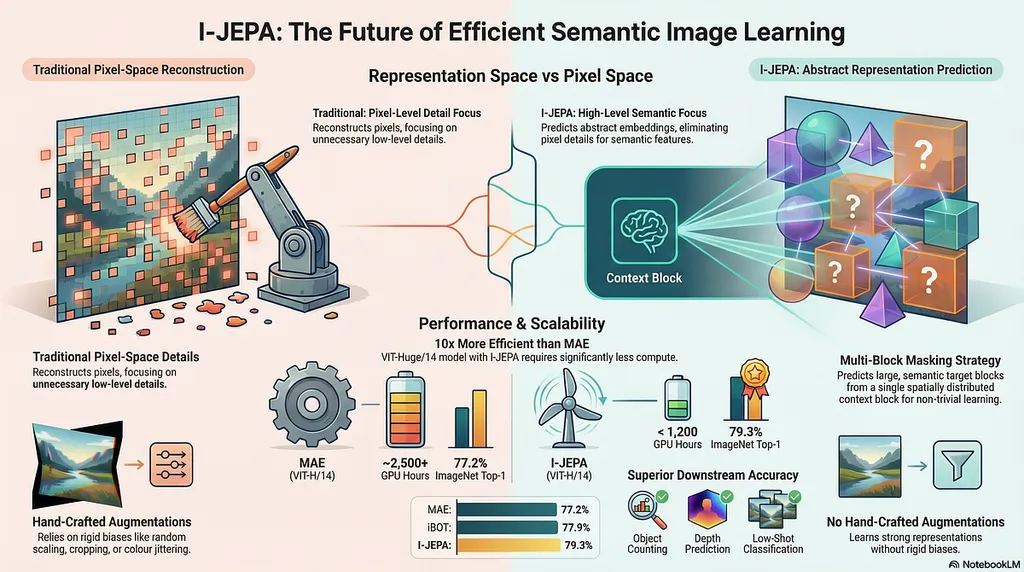
JEPA, or Joint Embedding Predictive Architecture, is a framework developed by Yann LeCun that focuses on predicting embeddings rather than raw pixels to improve AI stability and efficiency. It operates in latent space, capturing meaningful patterns and relationships in data without getting bogged down by irrelevant details. This approach supports the development of world models for tasks like planning and prediction in robotics and AI systems.
- ▪JEPA stands for Joint Embedding Predictive Architecture and is designed to make stable AI predictions in latent space.
- ▪Instead of predicting pixels, JEPA predicts compressed representations called embeddings, which capture essential features of the data.
- ▪JEPA contributes to building world models by handling state representation and prediction in latent space, making planning more efficient.
- ▪Operating in latent space allows JEPA to avoid the inefficiencies and brittleness of traditional generative models that reconstruct every detail.
- ▪The framework enables more effective planning by simulating only meaningful changes, not low-level sensory details.
Opening excerpt (first ~120 words) tap to expand
🧩What is JEPA? Joint Embedding Predictive Architecture Framework Prediction Within the Latent SpaceTahir7 min read·Mar 29, 2026--ListenSharePress enter or click to view image in full sizeTLDR:Learn about Jepa (Joint Embedding Predictive Architecture), Yann LeCun’s framework for stable AI predictions in latent space without generative decoding.Shoutout to Yann LeCunYou know how people are always saying you have to understand something before you can explain it. That’s true. But the opposite is also true. Explaining something helps you understand it. I’ve been trying to understand JEPA for a while now. Writing this will force me to get it right.So let’s start with the name. JEPA stands for Joint Embedding Predictive Architecture. That’s a mouthful.
…
Excerpt limited to ~120 words for fair-use compliance. The full article is at Medium.
Discussion
0 commentsMore from Medium