Webb and Hubble sink deep into the dazzling Whirlpool Galaxy — Space photo of the week
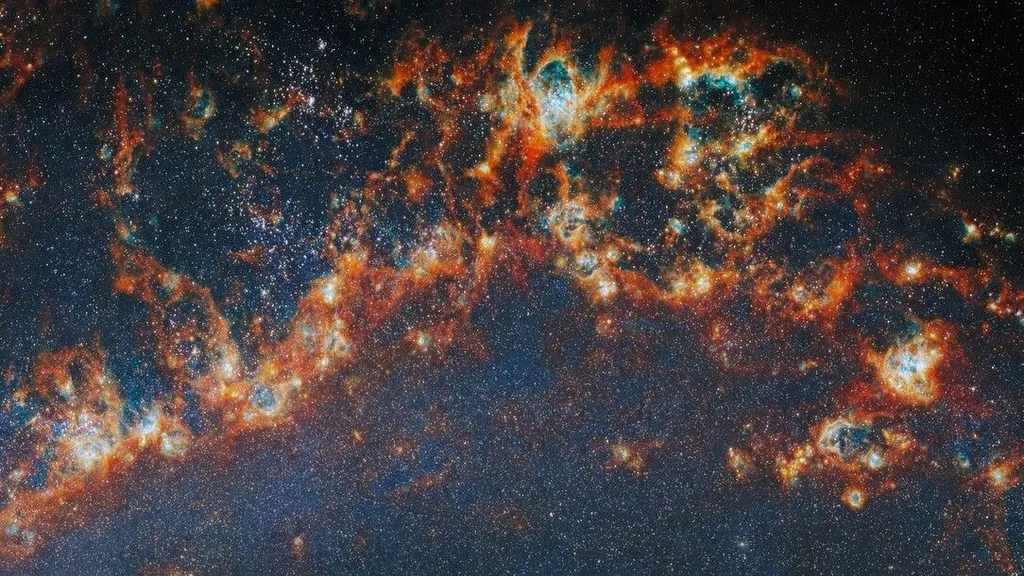
A new image of the Whirlpool Galaxy, combining data from the James Webb and Hubble space telescopes, sheds light on how stars emerge from their birth clouds. The observations reveal that larger star clusters disperse their natal gas faster than smaller ones, offering clues about galactic evolution. These findings may also help explain how the universe underwent reionization after the Big Bang.
- ▪The Whirlpool Galaxy is located 31 million light-years away in the constellation Canes Venatici.
- ▪Larger star groups clear their birth clouds in about 5 million years, while smaller groups take 7 to 8 million years.
- ▪Stellar feedback, driven by stellar winds, UV radiation, and supernovas, limits further star formation by dispersing gas.
- ▪The combined infrared and visible-light data reveal structures such as gas filaments, dust lanes, and young star clusters.
- ▪This research may help determine whether massive star clusters contributed to cosmic reionization after the early universe cooled.
Opening excerpt (first ~120 words) tap to expand
Space Astronomy Webb and Hubble sink deep into the dazzling Whirlpool Galaxy — Space photo of the week A striking new image of the Whirlpool Galaxy is helping astronomers solve one of the biggest mysteries in star formation. By Jamie Carter published 17 May 2026 in Features When you purchase through links on our site, we may earn an affiliate commission. Here’s how it works. Hubble and Webb team up to investigate one of the Whirlpool Galaxy's spiral arms. (Image credit: ESA/Webb, NASA & CSA, A. Pedrini, A.
…
Excerpt limited to ~120 words for fair-use compliance. The full article is at Live Science.
Discussion
0 commentsMore from Live Science