
Tim Cook’s Impeccable Timing
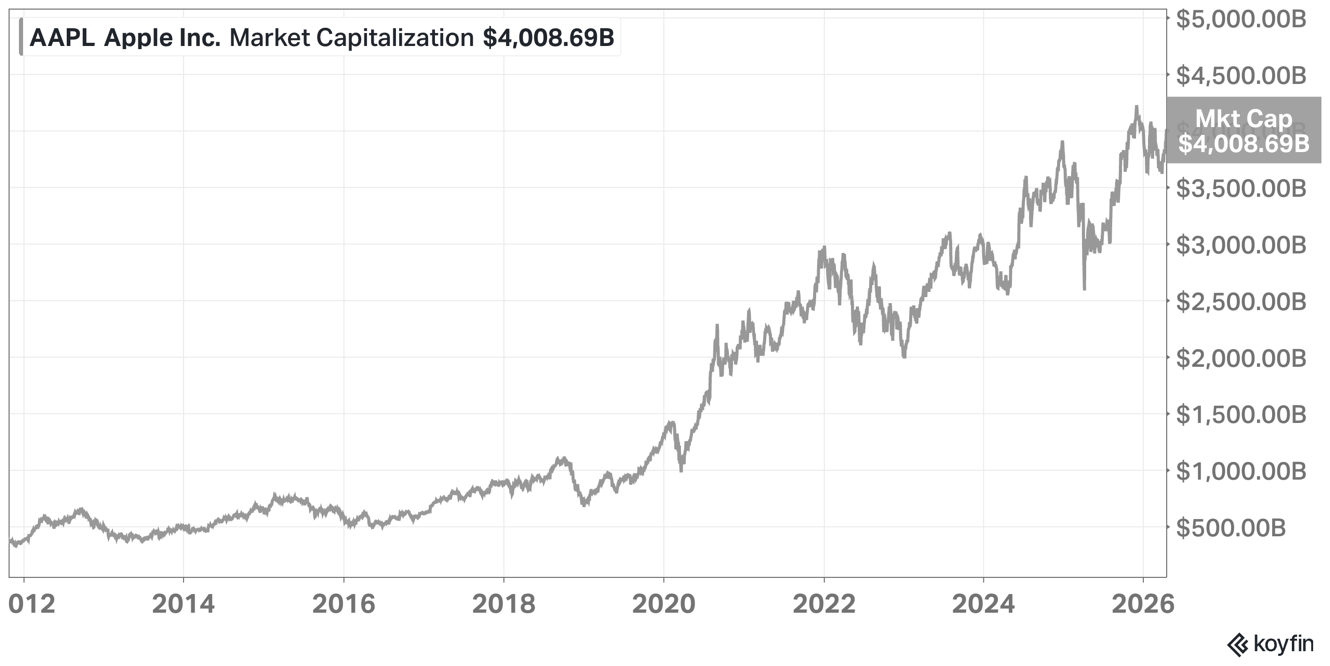
Tim Cook's tenure as Apple CEO, beginning in 2011 after Steve Jobs' death, was marked by extraordinary financial growth, operational mastery, and expansion of the iPhone and Services divisions. While Cook did not produce many '0 to 1' innovations, he successfully scaled Apple’s products and profitability, growing the company's value from $297 billion to $4 trillion. His leadership emphasized operational efficiency, supply chain control, and services revenue, though reliance on China and developer relations raise long-term sustainability questions. Cook will transition to Executive Chairman on September 1, 2026, leaving behind a transformed but debated legacy.
- ▪Tim Cook became CEO of Apple on August 24, 2011, six weeks before Steve Jobs passed away, and will step down as CEO on September 1, 2026, becoming Executive Chairman.
- ▪Under Cook’s leadership, Apple’s revenue grew 303%, profit 354%, and market value increased from $297 billion to $4 trillion.
- ▪Cook oversaw the global expansion of the iPhone, the launch of AirPods and Apple Watch, and the rise of Services, which now accounts for 26% of revenue and 41% of profit.
- ▪Apple’s reliance on China for manufacturing, while financially successful, has raised concerns about long-term strategic independence and resilience amid U.S.-China tensions.
- ▪The App Store and Google search deal significantly boosted Services revenue, but Apple’s 30% commission and developer policies have drawn criticism for prioritizing short-term financial gains over developer relations.
Full article excerpt tap to expand
Tim Cook’s Impeccable Timing Tuesday, April 21, 2026 Listen to Podcast Listen to this post: Log in to listen It’s the nature of business that the eulogy for a chief executive doesn’t happen when they die, but when they retire, or, in the case of Apple CEO Tim Cook, announce that they will step up to the role of Executive Chairman on September 1. The one morbid exception is when a CEO dies on the job — or quits because they are dying — and the truth of the matter is that that is where any honest recounting of Cook’s incredibly successful tenure as Apple CEO, particularly from a financial perspective, has to begin. The numbers, to be clear, are extraordinary. Cook became CEO of Apple on August 24, 2011, and in the intervening 15 years revenue has increased 303%, profit 354%, and the value of Apple has gone from $297 billion to $4 trillion, a staggering 1,251% increase. The reason for Cook’s accession in 2011 became clear a mere six weeks later, when Steve Jobs passed away from cancer on October 5, 2011. Jobs’ death isn’t the reason Cook was chosen — Cook had already served as interim CEO while Jobs underwent treatment in 2009 — but I think the timing played a major role in making Cook arguably the greatest non-founder CEO of all time. Zero to One Peter Thiel introduced the concept of Zero To One thusly: When we think about the future, we hope for a future of progress. That progress can take one of two forms. Horizontal or extensive progress means copying things that work — going from 1 to n. Horizontal progress is easy to imagine because we already know what it looks like. Vertical or intensive progress means doing new things — going from 0 to 1. Vertical progress is harder to imagine because it requires doing something nobody else has ever done. If you take one typewriter and build 100, you have made horizontal progress. If you have a typewriter and build a word processor, you have made vertical progress. Steve Jobs made 0 to 1 products, as he reminded the audience in the introduction to his most famous keynote: Every once in a while, a revolutionary product comes along that changes everything. First of all, one’s very fortunate if one gets to work on one of these in your career. Apple’s been very fortunate: it’s been able to introduce a few of these into the world. In 1984, we introduced the Macintosh. It didn’t just change Apple, it changed the whole computer industry. In 2001, we introduced the first iPod. It didn’t just change the way we all listen to music, it changed the entire music industry. Well, today we’re introducing three revolutionary products of this class. The first one: a widescreen iPod with touch controls. The second: a revolutionary mobile phone. And the third is a breakthrough Internet communications device. Three things…are you getting it? These are not three separate devices. This is one device, and we are calling it iPhone. Steve Jobs would, three years later, also introduce the iPad, which makes four distinct product categories if you’re counting. Perhaps the most important 0 to 1 product Jobs created, however, was Apple itself, which raises the question: what makes Apple Apple? The Cook Doctrine “What Makes Apple Apple” isn’t a new question; it was the central question of Apple University, the internal training program the company launched in 2008. Apple University was hailed on the outside as a Steve Jobs creation, but while I’m sure he green lit the concept, it was clear to me as an intern on the Apple…
This excerpt is published under fair use for community discussion. Read the full article at Stratechery by Ben Thompson.
Discussion
0 commentsMore from Stratechery by Ben Thompson

