The shared recipe behind search: Images, Shazam and RAG
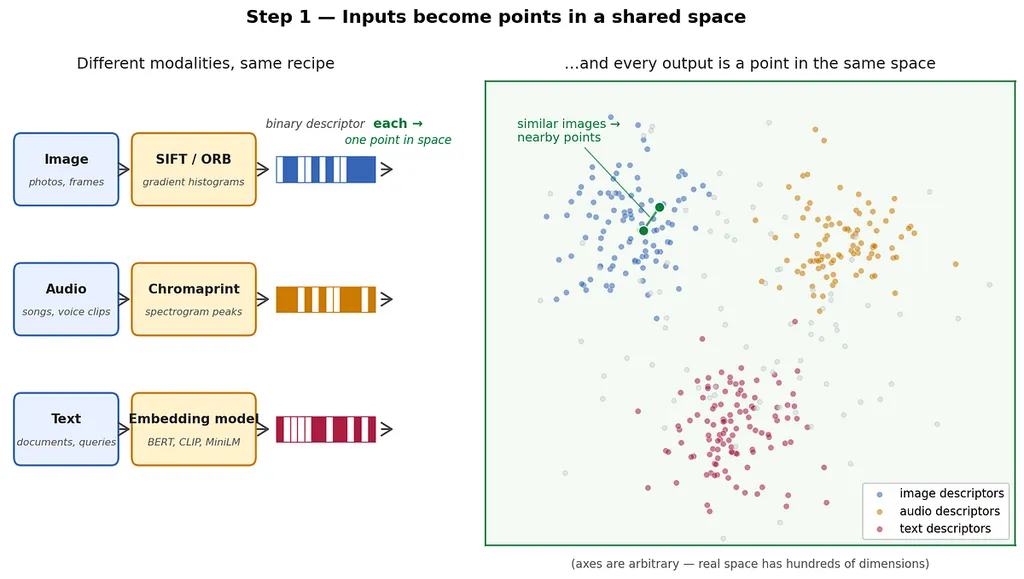
The article discusses the underlying similarities in various search technologies, such as image recognition, music identification, and text queries. It explains how these systems convert complex data into numerical vectors to facilitate efficient searching. The author also highlights the challenges of high-dimensional data and introduces techniques like Multi-Index Hashing for improving search accuracy.
- ▪RAG stands for retrieval-Augmented Generation, which is a common approach in modern search features.
- ▪The process involves creating descriptors that summarize data and finding similar items through nearest-neighbour search.
- ▪Techniques like SIFT and ORB are used to create fixed-size descriptors for images, enabling effective comparison.
Opening excerpt (first ~120 words) tap to expand
The shared recipe behind search: Images, Shazam and RAGPablo Carneiro Elias15 min read·Just now--ListenShareOr: why every modern “find me something similar” feature is the same problem in disguise — and what makes it hard at scale.RAG stands for retrieval-Augmented GenerationOpen Google Images, drop in a photo, and a few hundred milliseconds later you get every page that hosts a near-duplicate of it. Hum into Shazam and it tells you the song. Type a question into ChatGPT and, before answering, it pulls the three most relevant documents out of a database that might have a hundred million entries. Spotify suggests songs that feel like the one you’re playing.
…
Excerpt limited to ~120 words for fair-use compliance. The full article is at Medium.
Discussion
0 commentsMore from Medium