The Infrastructure Behind Making Local LLM Agents Useful
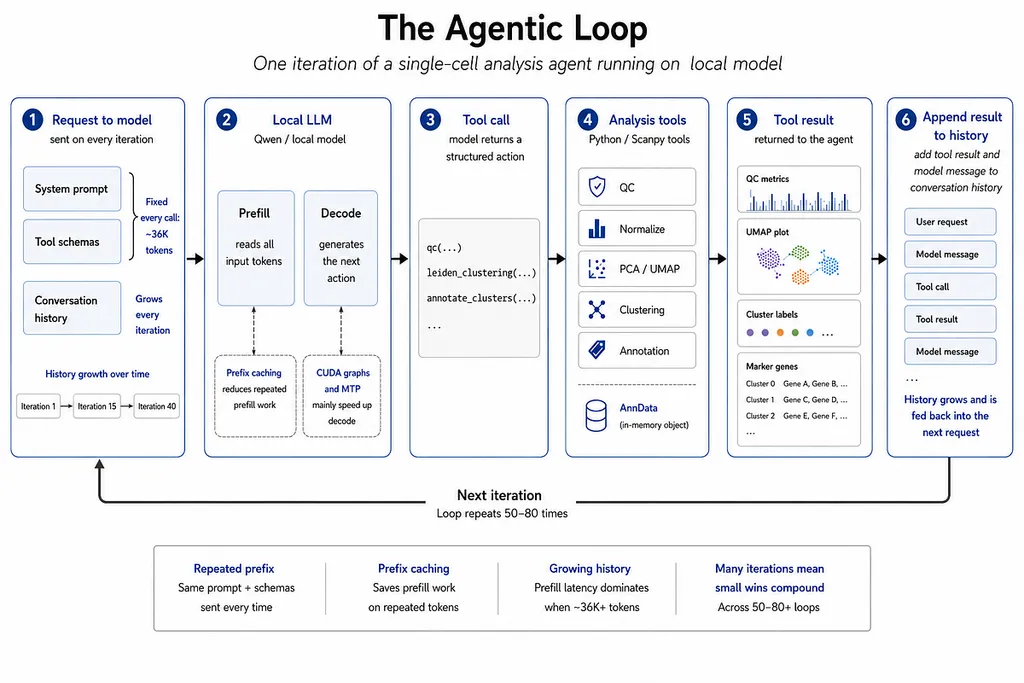
The article discusses the challenges and solutions in building a local language model (LLM) agent for automated single-cell RNA-seq analysis. It highlights the importance of reproducibility and structured data management in scientific workflows, which are often overlooked in simpler chatbot implementations. The author shares insights on optimizing inference speed and managing context for long-running sessions to enhance the usability of the agent.
- ▪Building a local LLM agent requires more than just downloading weights and starting a server; it involves managing complex workflows.
- ▪Scientific analysis demands reproducibility and structured records, which are not adequately addressed by standard chatbot skills.
- ▪The author implemented optimizations to improve inference speed and context management for long sessions in their agent.
Opening excerpt (first ~120 words) tap to expand
The Infrastructure Behind Making Local LLM Agents Actually UsefulHussen Mohammed Ibrahim17 min read·5 hours ago--ListenShareRunning a language model locally sounds straightforward. Download the weights, start the server, and send requests. That works for a chatbot, but it doesn’t automatically work for an agent. In my case, I’ve been building an agent for automated single-cell RNA-seq analysis. The idea is that, given raw data, the agent can run the full pipeline on its own, deciding which tools to call, reading the results, and working through the analysis step by step.You might ask why not just use something like Claude Code with a single-cell analysis Skill. The short answer is that for scientific workflows, that’s not quite enough.
…
Excerpt limited to ~120 words for fair-use compliance. The full article is at Medium.
Discussion
0 commentsMore from Medium