Testing MiniMax M2.7 via API on three real ML and coding workflows
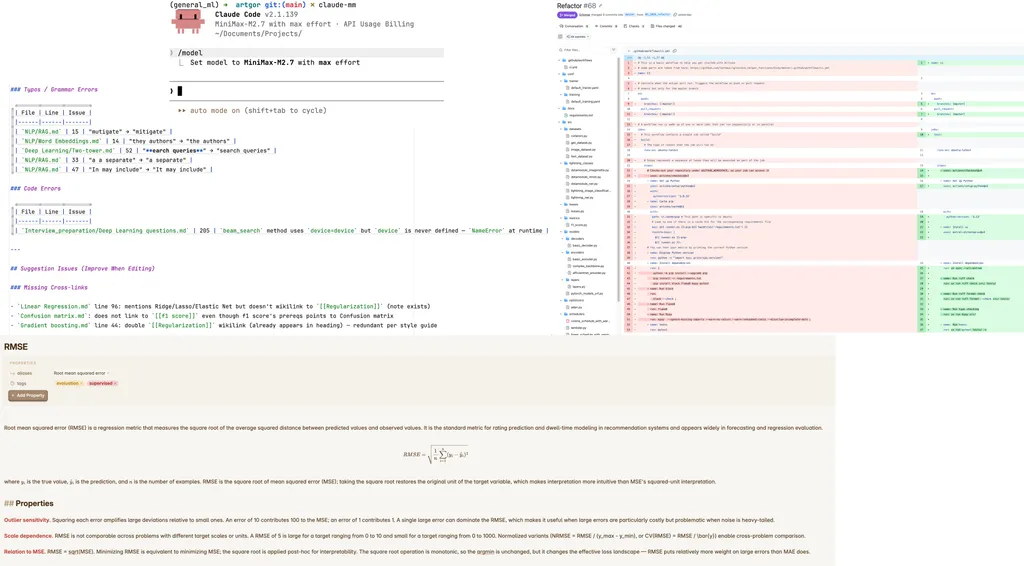
The article discusses testing the MiniMax M2.7 API on three machine learning and coding workflows. The results indicate that M2.7 performs well with explicit constraints but struggles with implicit context. The author emphasizes the importance of both model quality and harness design in achieving effective outcomes.
- ▪The author tested MiniMax M2.7 API on workflows including a Kaggle competition entry and updating a PyTorch project.
- ▪M2.7 was found to be useful when tasks had clear boundaries and explicit constraints.
- ▪The author noted that some challenges arose when important context was left implicit, affecting both M2.7 and the comparison model, Opus 4.7.
Opening excerpt (first ~120 words) tap to expand
Testing MiniMax M2.7 via API on three real ML and coding workflows I recently got access to some MiniMax M2.7 API credits, so I decided to plug this model directly into Claude Code and run it on three workflows I do regularly. The same tasks were run using Claude Opus 4.7 as the comparison baseline. The three workflows: scaffolding an entry for an active Kaggle competition, drafting and auditing knowledge-base notes for my Obsidian vault, and updating an old PyTorch project that became outdated. I wanted to find out how well M2.7 works inside an agentic loop when the task has clear boundaries. The results were consistent across the three runs: M2.7 was useful when the constraints were explicit, and the output format was concrete.
…
Excerpt limited to ~120 words for fair-use compliance. The full article is at artgor.
Discussion
0 commentsMore from artgor