Teaching an LLM to Speak Vestaboard Note: Building Vestaboard AI
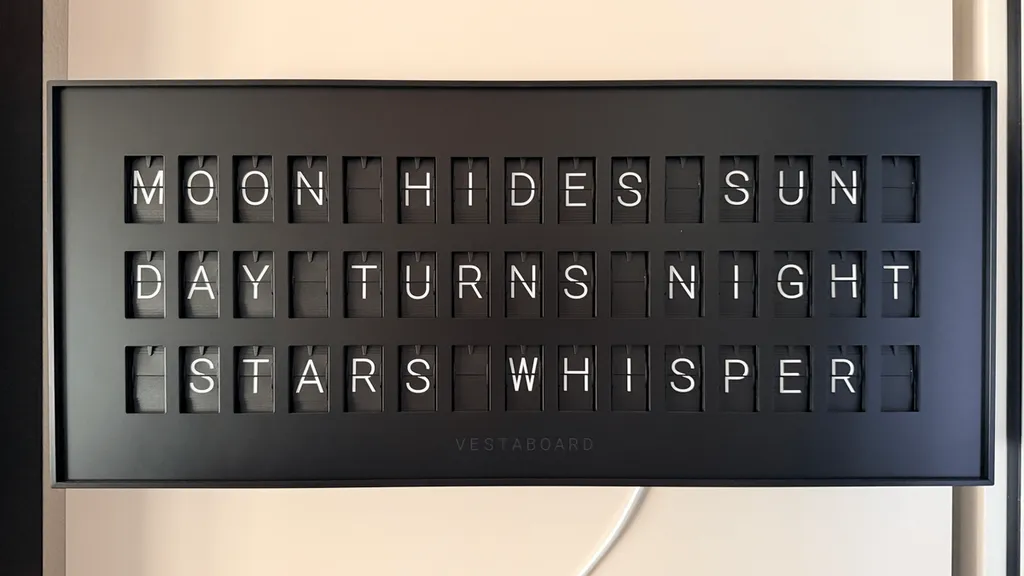
A Vestaboard is a split‑flap display limited to 45 characters across three lines and a restricted glyph set. The author created Vestaboard AI, a Python service that queries an OpenAI‑compatible model, validates the output against the board’s constraints, and posts the message on a schedule. The system separates a Streamlit UI for configuration from a scheduler daemon, both coordinated via a secure config file.
- ▪The Vestaboard can only display 45 characters using a specific set of letters, digits, punctuation, and color codes.
- ▪Vestaboard AI requests a message from an LLM, then repeatedly validates and truncates it until it fits the board’s format before delivering it via either a cloud or local API.
- ▪The architecture splits responsibilities between a UI process that edits configuration and a scheduler daemon that generates and sends messages, communicating solely through an atomic config.json file.
- ▪Core modules handle configuration, character‑set mapping, compilation to Vestaboard’s integer code grid, LLM interaction, and delivery, with a design principle of never trusting the model’s raw output.
Opening excerpt (first ~120 words) tap to expand
Teaching an LLM to Speak Vestaboard Note: Building Vestaboard AI Sascha Corti 27 Jun 2026 • 9 min read Share A Vestaboard is a split-flap display — the kind that used to clatter through train-station departure boards — reimagined as a connected home object. It's gorgeous, it's tactile, and it has a wonderfully small canvas: 3 lines of 15 characters, so 45 characters of real content, drawn from a restricted alphabet of letters, digits, a handful of symbols, and a few color chips.That constraint is exactly what makes it a fun target for a language model. LLMs love to ramble; a Vestaboard Note physically cannot.
…
Excerpt limited to ~120 words for fair-use compliance. The full article is at Corti.com.
Discussion
0 commentsMore from Corti.com