Tabulation Tribulations
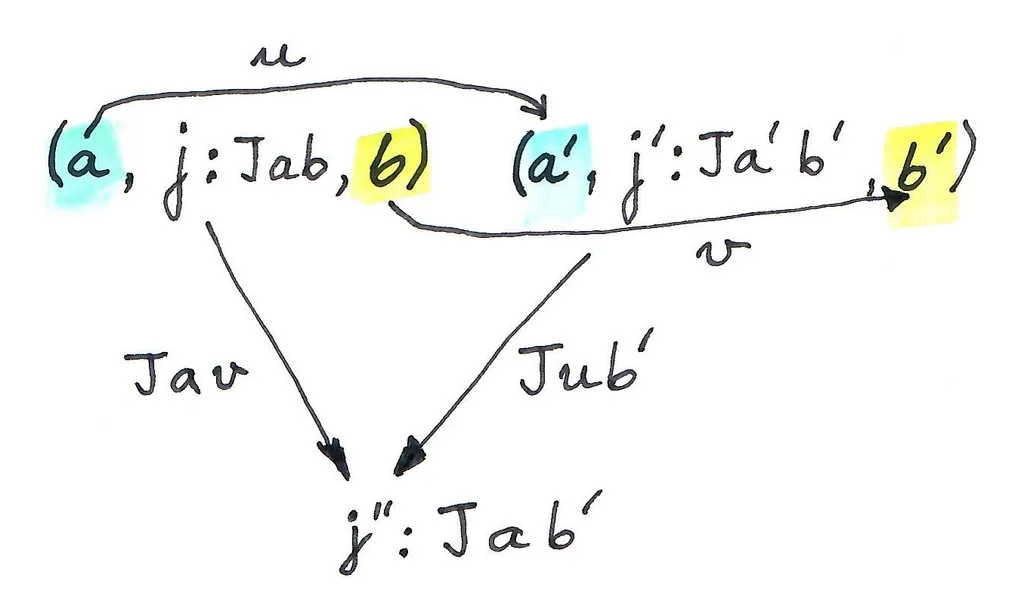
The article discusses the concept of a tabulation in a double category, which is a way of representing a profunctor as a 0-cell equipped with two projections. A tabulation is defined using its universal property, which involves a 1-dimensional and a 2-dimensional condition. The article explains how these conditions work and how they can be used to construct a mapping from a horizontal 1-cell to a tabulation.
- ▪A profunctor can be viewed as a proof-relevant relation.
- ▪A tabulation of a horizontal arrow is a 0-cell equipped with two projections.
- ▪The universal property of a tabulation involves a 1-dimensional and a 2-dimensional condition.
Opening excerpt (first ~120 words) tap to expand
Previously: Bending, Yanking, and Cartesian Squares in Double Categories. We all know what a graph of a function is: it’s a set of pairs , where . Similarly, a graph of a relation is a set of pairs where is related to . A profunctor can be viewed as a proof-relevant relation. So a graph of a profunctor is a triple, which contains two objects and a proof, or a witness, that they are related. The witness in this case is any element of the set . If the set is empty, it means that the objects are unrelated. Such triples form a category, which is often called the category of elements of a profunctor. Given a profunctor , an object in the category of elements is a triple . We interpret as a witness that is related to .
…
Excerpt limited to ~120 words for fair-use compliance. The full article is at Bartosz Milewski's Programming Cafe.
Discussion
0 commentsMore from Bartosz Milewski's Programming Cafe