Stitch Together Lots of Little HTML Pages with Navigations for Interactions
The article discusses an approach to web development that prioritizes simple HTML page navigations over complex JavaScript interactions. By using CSS view transitions and minimal JavaScript, the author creates fast, robust, and accessible user experiences. This method emphasizes fundamental browser functionality, ensuring compatibility across devices and browsers while maintaining intuitive navigation.
- ▪The author advocates for using multiple small HTML pages instead of JavaScript-heavy single-page interactions.
- ▪Navigation is enhanced with CSS view transitions, providing visual effects without relying on JavaScript.
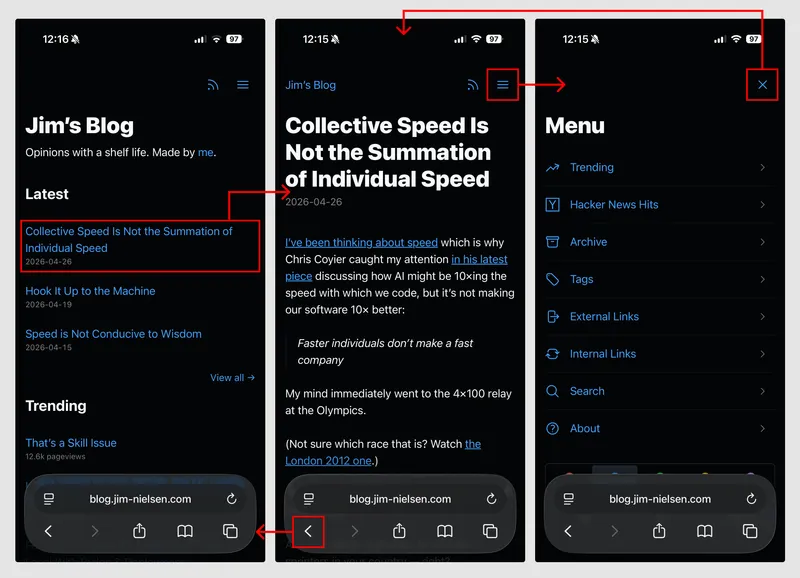
- ▪The menu system works as a separate page, linked via standard HTML anchors and enhanced with minimal JavaScript for history management.
- ▪Even without JavaScript or on older browsers, the site remains fully functional due to reliance on basic link navigation.
- ▪This design approach prioritizes speed, accessibility, and simplicity by treating the browser as a document navigator rather than a runtime.
Opening excerpt (first ~120 words) tap to expand
Reminder: You Can Stitch Together Lots of Little HTML Pages With Navigations For Interactions 2026-05-03 #html #cssViewTransitions #myBlog I wrote about building websites with LLMs — (L)ots of (L)ittle ht(M)l page(s) — and I think it’s time for a post-mortem on that approach: I like it. I’ve tweaked a few things from that original post but the underlying idea is still the same, which I would describe as: Avoid in-page interactions that require JavaScript in favor of multi-page navigations that rely on HTML and are enhanced with CSS view transitions (and a dash of JS if/where prudent). As an example, on my blog I have a “Menu”. It doesn’t “expand” or “slide out” or “pop in” or whatever else you can do with JS.
…
Excerpt limited to ~120 words for fair-use compliance. The full article is at Hacker News: Front Page.
Discussion
0 commentsMore from Hacker News: Front Page