Ontology vs. Semantic Layer
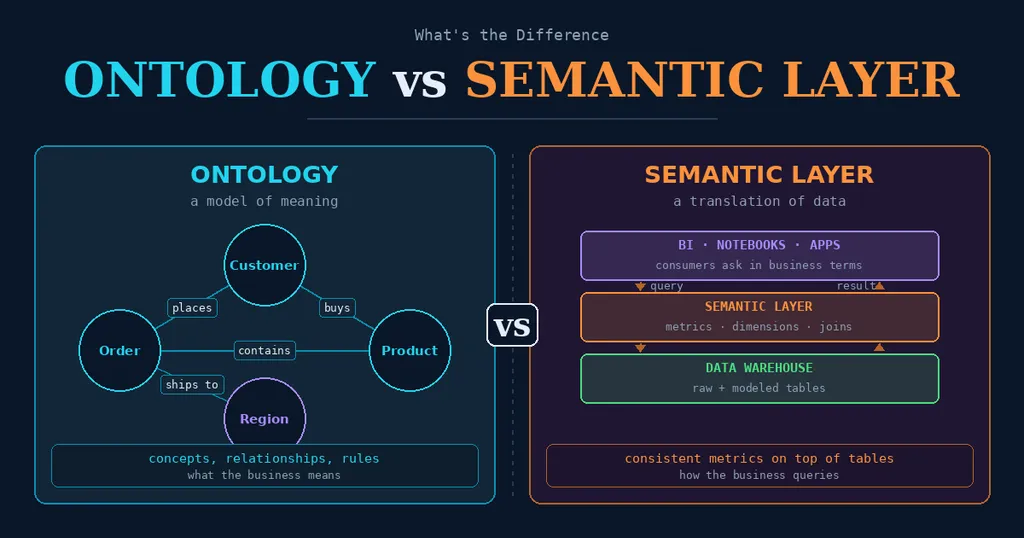
The article clarifies the distinctions between ontology and semantic layer in data management. An ontology defines business concepts and their relationships, while a semantic layer is software that translates data into business terms for users. Understanding both is essential for effective data practices, as they serve different but complementary roles.
- ▪An ontology is a formal model that defines concepts and relationships in a business domain.
- ▪A semantic layer is software that translates raw data into business concepts for users.
- ▪Confusion arises because a semantic layer can express parts of an ontology, particularly quantitative aspects.
Opening excerpt (first ~120 words) tap to expand
Home › Articles › Ontology vs Semantic Layer: What Each One Actually Is Contents What an Ontology Is What a Semantic Layer Is Where the Confusion Starts 1. Scope 2. Coupling to technology 3. Authorship Side-by-Side Comparison What Goes Wrong Without an Ontology What Goes Wrong Without a Semantic Layer How the Two Should Fit Together When You Need Which The Low Hanging Data Take Next Steps May 22, 2026 · 10 min read Ontology vs Semantic Layer: What Each One Actually Is 🌳 High Hanging Fruit Share: X LinkedIn The words ontology and semantic layer have been moving in and out of data team vocabulary for a decade, and they have started showing up in the same sentences as if they were interchangeable. They are not. One describes what your business means by the words it uses.
…
Excerpt limited to ~120 words for fair-use compliance. The full article is at Low Hanging Data.
Discussion
0 commentsMore from Low Hanging Data