NASA’s MAVEN Detects Atmospheric Effect on Mars That ‘No One Expected’
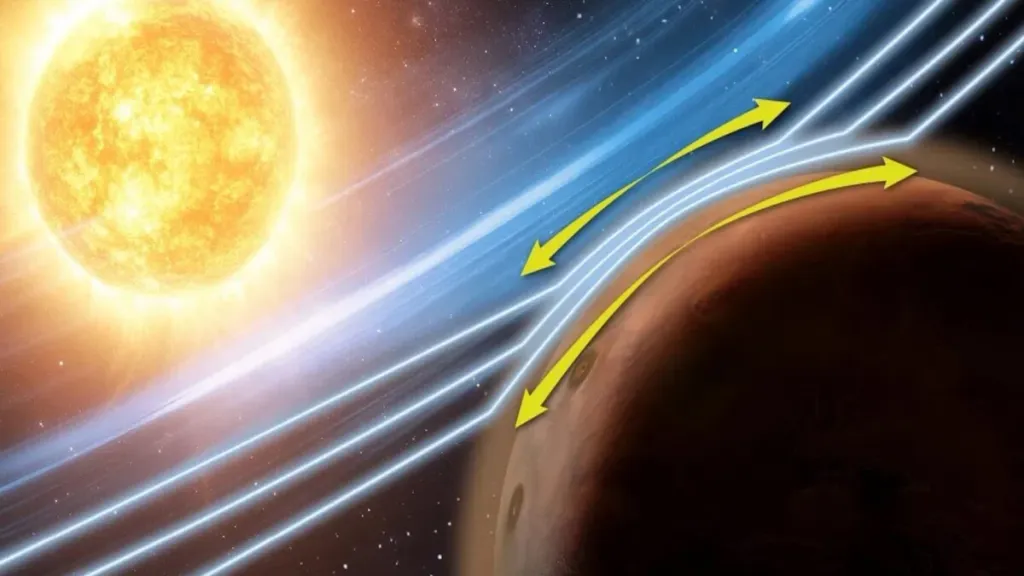
NASA's MAVEN mission has detected the Zwan-Wolf effect in Mars' atmosphere, a phenomenon previously thought to only occur in magnetized environments like Earth's. This discovery challenges existing assumptions about Mars' atmospheric behavior and opens new avenues for research on unmagnetized planets. The findings were made during a solar storm in December 2023, highlighting the interaction between solar activity and Martian atmospheric dynamics.
- ▪The Zwan-Wolf effect was observed in Mars' atmosphere for the first time, surprising scientists.
- ▪This phenomenon involves charged particles being funneled through magnetic structures, similar to behavior seen in Earth's magnetosphere.
- ▪The MAVEN spacecraft, launched in 2013, aims to study Mars' atmosphere and its loss over billions of years.
Opening excerpt (first ~120 words) tap to expand
We know Mars to be many things: dusty, cold, and missing a global magnetic field. In a recent discovery that baffled scientists, a space weather phenomenon previously associated with powerful magnetic fields was observed on Mars for the first time.cnx.cmd.push(function(){cnx({"playerId":"92b7b46b-43ed-4e0e-b21b-2c999302d9d7","settings":{"advertising":{"macros":{"AD_UNIT":"/23178111854/od.gizmodo.com/article","CHILD_UNIT":"article","POST_ID":"2000760584","POST_TYPE":"post","CHANNEL":"science","SECTION":"space","SUBSECTION":"","CATEGORIES":"space","TAGS":"mars,maven,nasa","NOP":"0"},"timeBeforeFirstAd":0}}}).render("cnx-player-main")}); Using data from NASA’s MAVEN (Mars Atmosphere and Volatile Evolution) mission, scientists identified the Zwan-Wolf effect in Mars’ atmosphere.
…
Excerpt limited to ~120 words for fair-use compliance. The full article is at Gizmodo.
Discussion
0 commentsMore from Gizmodo