NASA’s Exoplanet Hunter Reveals its Most Complete Look at the Night Sky
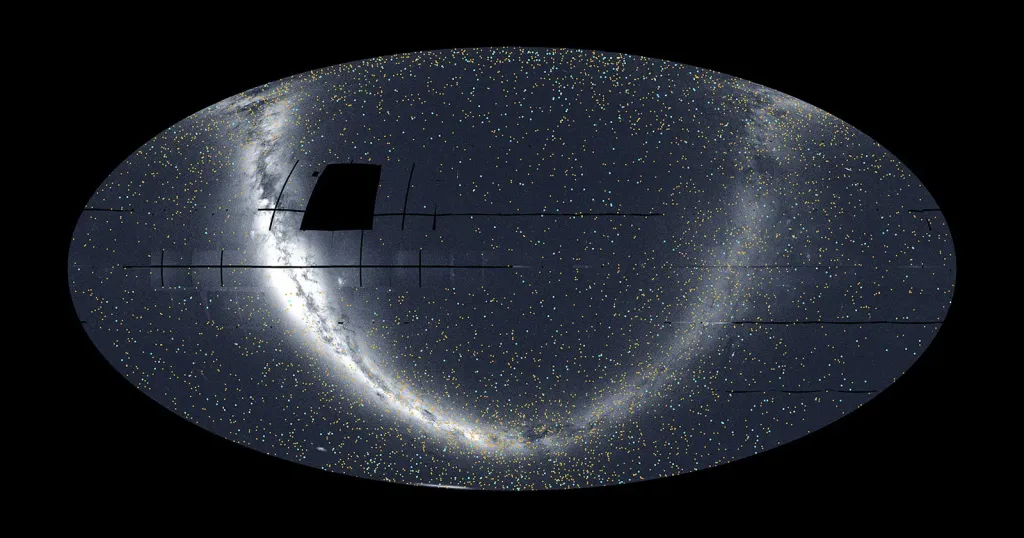
NASA's Transiting Exoplanet Survey Satellite (TESS) has released its most comprehensive view of the night sky to date. The mosaic includes 679 confirmed exoplanets and over 5,000 candidate exoplanets, showcasing a wide variety of celestial bodies. TESS has significantly advanced our understanding of exoplanets and their potential for hosting life.
- ▪The all-sky mosaic was constructed from 96 TESS sectors captured over eight years.
- ▪TESS has discovered 679 confirmed exoplanets and nearly 5,200 candidate exoplanets.
- ▪The satellite's cameras monitor a strip of the sky for 27 days and nights with a two-second cadence.
Opening excerpt (first ~120 words) tap to expand
NASA’s Exoplanet Hunter Reveals its Most Complete Look at the Night Sky May 21, 2026 Jeremy Gray ‘This view of the whole sky was constructed from 96 TESS sectors. By the end of September 2025, when the last image of this mosaic was captured, TESS had discovered 679 exoplanets (blue dots) and 5,165 candidates (orange dots). The glowing arc running through the center is the plane of the Milky Way. The Large Magellanic Cloud can be seen along the bottom edge just left of center. Black areas within the oval indicate regions TESS has not yet imaged.’ | Credit: NASA/MIT/TESS and Veselin Kostov (University of Maryland College Park) NASA’s Transiting Exoplanet Survey Satellite (TESS) has released a new mosaic that offers its most complete view of the night sky yet.
…
Excerpt limited to ~120 words for fair-use compliance. The full article is at PetaPixel.
Discussion
0 commentsMore from PetaPixel