MemEye: A Visual-Centric Evaluation Framework for Multimodal Agent Memory
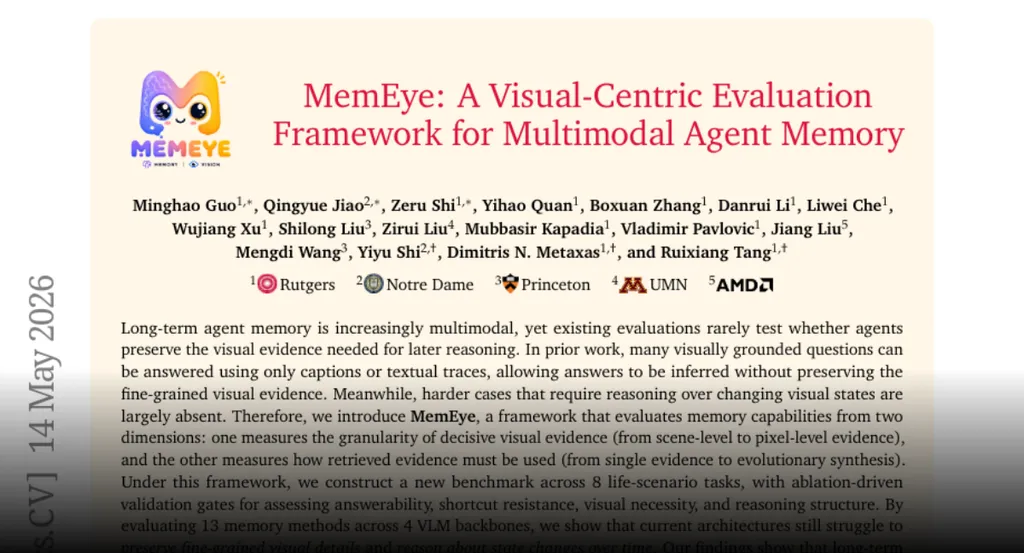
MemEye is a new framework designed to evaluate multimodal agent memory by focusing on visual evidence granularity and retrieval complexity. It introduces a benchmark across eight life-scenario tasks to assess how well agents retain and utilize visual information. The findings indicate that current architectures struggle with preserving fine-grained visual details and reasoning about changes over time.
- ▪MemEye evaluates multimodal agent memory through visual evidence granularity and retrieval usage complexity.
- ▪The framework includes a benchmark across eight life-scenario tasks with various validation gates.
- ▪Current memory methods show difficulties in preserving detailed visual information and reasoning about temporal changes.
Opening excerpt (first ~120 words) tap to expand
Papers arxiv:2605.15128 Copy markdown MemEye: A Visual-Centric Evaluation Framework for Multimodal Agent Memory Published on May 14 · Submitted by Zeru Shi on May 15 Upvote 55 +47 Authors: Minghao Guo ,Qingyue Jiao ,Zeru Shi ,Yihao Quan ,Boxuan Zhang ,Danrui Li ,Liwei Che ,Wujiang Xu ,Shilong Liu ,Zirui Liu ,Mubbasir Kapadia ,Vladimir Pavlovic ,Jiang Liu ,Mengdi Wang ,Yiyu Shi ,Dimitris N. Metaxas ,Ruixiang Tang Abstract MemEye framework evaluates multimodal agent memory by measuring visual evidence granularity and retrieval usage complexity across 8 life-scenario tasks. AI-generated summary Long-term agent memory is increasingly multimodal, yet existing evaluations rarely test whether agents preserve the visual evidence needed for later reasoning.
…
Excerpt limited to ~120 words for fair-use compliance. The full article is at Huggingface.
Discussion
0 commentsMore from Huggingface