Jupiter Flings Particles to Nearly the Speed of Light. The Weird Part Is How
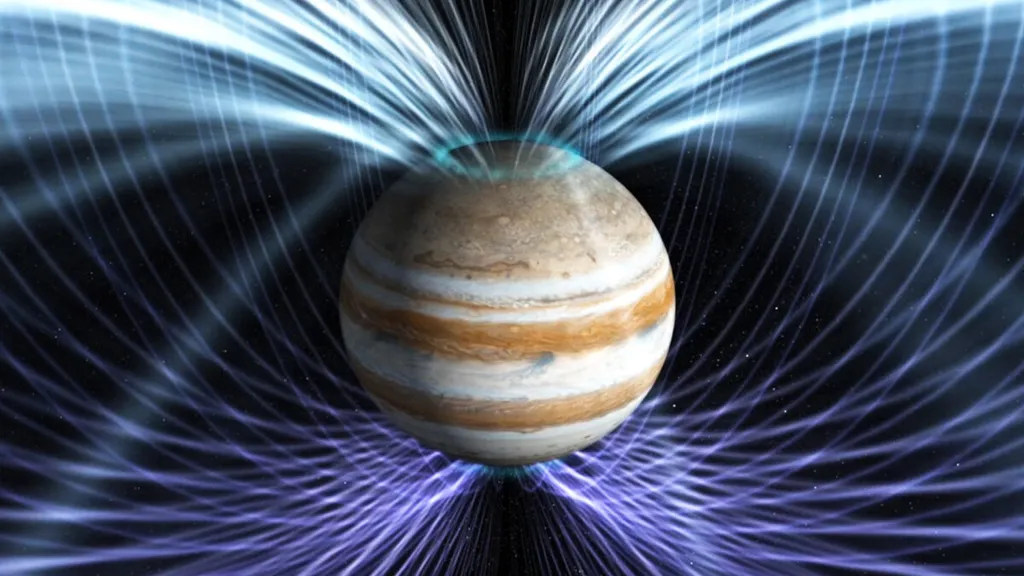
Researchers have discovered that Jupiter's bow shock creates large, naturally occurring particle accelerators that can accelerate electrons to near the speed of light. This process, observed in Jupiter's turbulent foreshock, may also apply to cosmic scales beyond our solar system. The findings suggest that the physics governing particle acceleration on Earth could be similar to that in extreme cosmic environments.
- ▪Jupiter's bow shock is a region where its magnetosphere collides with the solar wind, creating intense density and pressure changes.
- ▪The foreshock upstream of the bow shock acts as a natural particle accelerator, outperforming forces in the shock boundary.
- ▪Data from NASA's Juno spacecraft revealed that particles in the foreshock can reach relativistic speeds, challenging previous models of particle acceleration.
Opening excerpt (first ~120 words) tap to expand
Our most powerful particle accelerators mimic near-light speeds of cosmic particles. But no upgrade may be capable of replicating the extreme complexity of the most violent objects in the universe. To understand these environments, astronomers are using entire planets as natural labs, including Jupiter’s tumultuous magnetosphere.cnx.cmd.push(function(){cnx({"playerId":"92b7b46b-43ed-4e0e-b21b-2c999302d9d7","settings":{"advertising":{"macros":{"AD_UNIT":"/23178111854/od.gizmodo.com/article","CHILD_UNIT":"article","POST_ID":"2000766987","POST_TYPE":"post","CHANNEL":"science","SECTION":"space","SUBSECTION":"","CATEGORIES":"space","TAGS":"jupiter,planetary-science,plasma-physics","NOP":"0"},"timeBeforeFirstAd":0}}}).render("cnx-player-main")}); In a Nature paper published today, researchers…
Excerpt limited to ~120 words for fair-use compliance. The full article is at Gizmodo.
Discussion
0 commentsMore from Gizmodo