Gateway manufacturer finally acknowledges issue, fails to mention "corrosion"
"At this time, further comments would be premature."
Full article excerpt tap to expand
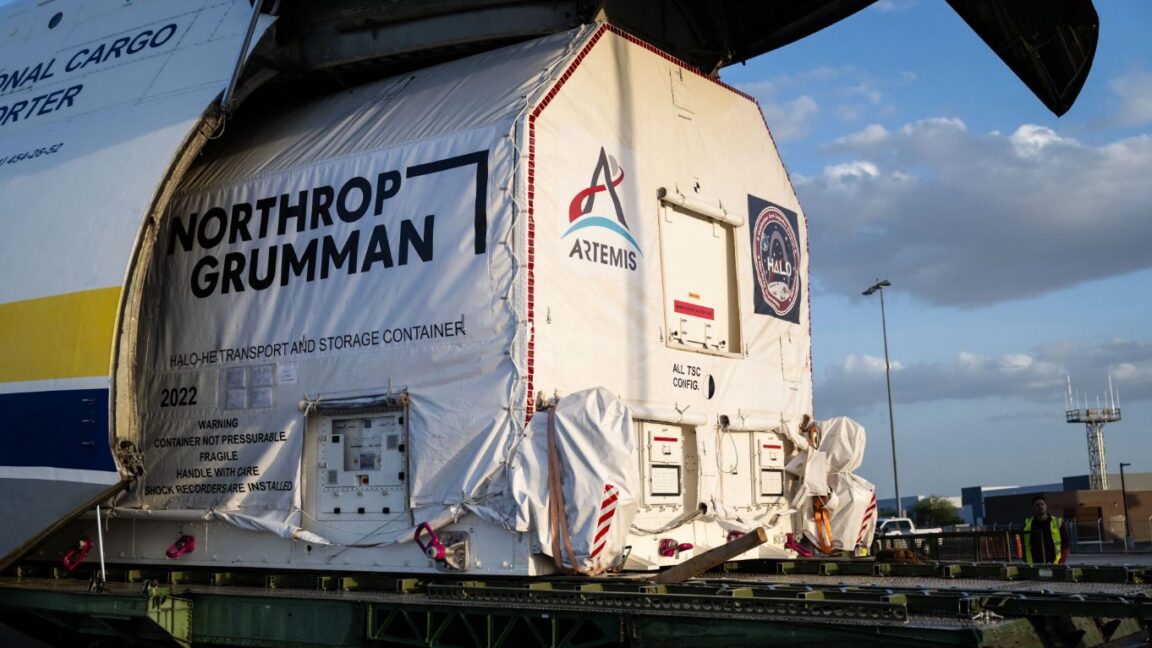
Thales talks Gateway manufacturer finally acknowledges issue, fails to mention “corrosion” “At this time, further comments would be premature.” Eric Berger – Apr 27, 2026 10:02 am | 52 The HALO module arrives in North America from Italy in 2025. Credit: Northrop Grumman The HALO module arrives in North America from Italy in 2025. Credit: Northrop Grumman Text settings Story text Size Small Standard Large Width * Standard Wide Links Standard Orange * Subscribers only Learn more Minimize to nav One of the more intriguing space stories in a while broke last week when NASA Administrator Jared Isaacman said during a congressional hearing that the two habitation modules built for the Lunar Gateway had been corroded. The immediate response to these comments on Wednesday before a House committee from some space industry observers was doubt—Isaacman, they said, must be lying. However, the primary contractor for the Habitation and Logistics Outpost, Northrop Grumman, soon acknowledged there was a manufacturing irregularity. On Friday, the European Space Agency, providing the other habitation module (I-HAB), acknowledged that there had been “corrosion” observed. The pressure vessel structures for both modules were manufactured by a French-Italian firm, Thales Alenia Space. On Friday, Axiom Space, which also ordered a pressurized structure for its private space station from Thales, told Ars it had experienced “similar” issues with its Module 1. Thales finally talks Thales had remained mum about these various issues and did not offer a comment until Monday morning, nearly five days after Isaacman’s testimony. The company’s statement, in full, reads: Our teams are working hand in hand with our longstanding customer Northrop Grumman to ensure that the HALO module fully meets the mission’s requirements, using NASA-approved processes. A well-known metallurgical behavior was found at the surface of the module, which will be fixed by the end of the third quarter of 2026. As for Lunar I-HAB, which is still in our facilities to date, we are also teaming up with ESA to fix soon the same related issue. Our company, together with its customers and partners, is used to face and solve this kind of situations, in this very-challenging space environment. As an example, a metallurgical behavior of this kind occurred decades ago during the manufacturing of elements for the International Space Station (ISS). The ISS’ pressurized modules have proved to be highly performant, and continue to operate reliably, exceeding their original expected lifespan. With nearly 50% of the ISS’ pressurized volume built by our company still functioning after 25 years, we leverage this experience to address the current situation with agility, expertise and full technical control. At this time, further comments would be premature. For more information, please refer to Northrop Grumman for HALO and ESA for Lunar I-HAB. Presumably, the “well-known metallurgical behavior” is a euphemism for corrosion. Isaacman’s corrosion comments were in response to a question about the future of the HALO module. NASA halted development of the Lunar Gateway a little more than a month ago, preferring to focus on lunar surface activities instead of a small lunar space station. The Gateway’s corrosion issues, which had persisted for months, remained a well-kept secret until Isaacman disclosed the issue. Since Gateway’s demise, Northrop has been positioning the HALO module as an option for a surface habitat,…
This excerpt is published under fair use for community discussion. Read the full article at Ars Technica - All content.
Discussion
0 commentsMore from Ars Technica - All content