DNA milestone may move US to disinter unidentified Pearl Harbor victims
Enough family reference samples collected to identify at least 60% of disinterred USS Arizona crew members The United States government could move to disinter the remains of unidentified USS Arizona crew members who were killed in the surprise attack on Pearl Harbor in 1941 after the clinching of a key DNA-related milestone, officials recently announced. Before that announcement, officials determined enough family reference samples had been collected for comparison with DNA taken from remains –
Full article excerpt tap to expand
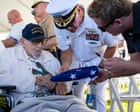
An attendee asks Pearl Harbor survivor Ira ‘Ike’ Schab, 103, to sign a US flag during the 82nd Pearl Harbor remembrance day ceremony on 7 December 2023, at Pearl Harbor in Honolulu, Hawaii. Photograph: Mengshin Lin/APView image in fullscreenAn attendee asks Pearl Harbor survivor Ira ‘Ike’ Schab, 103, to sign a US flag during the 82nd Pearl Harbor remembrance day ceremony on 7 December 2023, at Pearl Harbor in Honolulu, Hawaii. Photograph: Mengshin Lin/APUS militaryDNA milestone may move US to disinter unidentified Pearl Harbor victimsEnough family reference samples collected to identify at least 60% of disinterred USS Arizona crew membersRamon Antonio VargasMon 27 Apr 2026 06.00 EDTLast modified on Mon 27 Apr 2026 06.01 EDTSharePrefer the Guardian on GoogleThe United States government could move to disinter the remains of unidentified USS Arizona crew members who were killed in the surprise attack on Pearl Harbor in 1941 after the clinching of a key DNA-related milestone, officials recently announced.Before that announcement, officials determined enough family reference samples had been collected for comparison with DNA taken from remains – along with medical and dental records – for the individual identification of at least 60% of the battleship crew members to be disinterred, said a statement on Friday from the agency tasked with identifying US military personnel who are unaccounted for after past conflicts.It was not immediately clear precisely when the disinterments might begin, the statement from the Defense POW/MIA Accounting Agency (DPAA) said. According to the DPAA, they first still require approval from the Pentagon.Nonetheless, the DPAA’s statement said that reaching what it called the 60% threshold allowed it “to formally request and begin planning” the disinterments – a key breakthrough for the ongoing project to conclusively establish the identities of USS Arizona crew members who were killed at Hawaii’s Pearl Harbor but not readily recognizable.Japan’s attack on Pearl Harbor killed more than 2,400 American military members, including 1,177 USS Arizona crew members. Hundreds still are entombed inside the Arizona, which lies where it sank and is one of the most hallowed sites in the US, which entered the second world war in the attack’s aftermath.Meanwhile, many of those who could be pulled from the Arizona’s wreckage were burned beyond recognition, and buried as “unknowns” in nearby cemeteries, information from the National World War II Museum in New Orleans shows.In 1947, 170 of those unknown US military service members were exhumed, and more than 100 were identified. But dozens were declared “unrecoverable” and were reburied at the national memorial cemetery of the Pacific in the Hawaiian capital of Honolulu.View image in fullscreenThe USS Arizona during the Japanese attack on Pearl Harbor, Hawaii, on 7 December 1941. Photograph: APAmong those on the Arizona who were killed but unaccounted for was Robert Edwin Kline, a US navy gunner’s mate second class. His grandnephew Kevin Kline in 2023 founded Operation 85, a civilian-led and privately funded organization that dedicated itself to identifying the Arizona’s remaining unknowns.It hoped to replicate the success of a prior effort that identified more than 360 crew members who died on the USS Oklahoma during Pearl Harbor and had previously been unaccounted for, the National World War II Museum noted.The DPAA’s statement on Friday specifically thanked Kevin Kline and his…
This excerpt is published under fair use for community discussion. Read the full article at the Guardian.
Discussion
0 commentsMore from the Guardian