Clasp: A four-stage supply-chain attack pattern via emergency patches
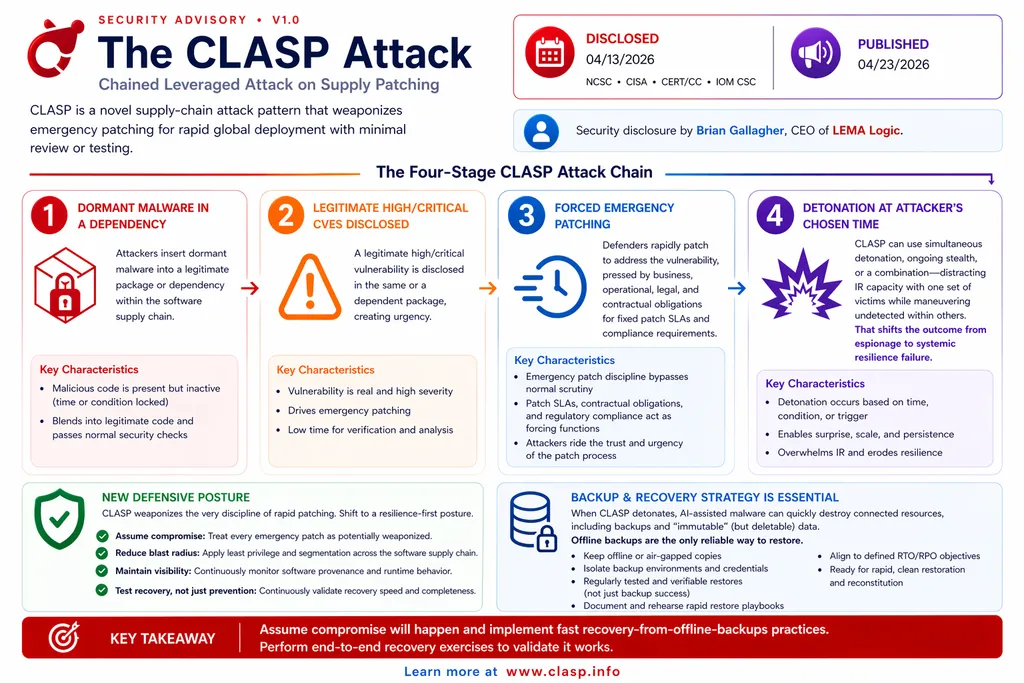
CLASP (Chained Leveraged Attack on Supply Patching) is a four-stage supply-chain attack that exploits emergency patching cycles to rapidly deploy pre-planted malware, using legitimate High/Critical CVE disclosures as a trigger. The attack leverages AI-generated vulnerability discoveries to overwhelm maintainers and force rapid patch deployment, leaving no time to detect malicious code already merged into software. Organizations with strong patching discipline are most at risk, as they deploy updates fastest. The recommended response shifts from prevention to ensuring rapid recovery via offline backups and bare-metal restoration readiness.
- ▪CLASP involves planting dormant malware in a widely used software package, then triggering its global deployment via a legitimate High/Critical CVE disclosure that forces emergency patching.
- ▪AI models like Mythos and GPT-5.4-Cyber have accelerated the discovery of vulnerabilities, flooding maintainers with reports and creating conditions ideal for hiding malicious code in urgent patches.
- ▪The better an organization's patching process, the more vulnerable it is to CLASP, as rapid deployment ensures faster installation of compromised code.
- ▪No confirmed CLASP attacks have occurred as of April 2026, but all individual stages have precedent in past incidents like SolarWinds and the xz-utils compromise.
- ▪Defenders are advised to prioritize physical offline backups and regular bare-metal recovery exercises, as prevention alone is no longer sufficient.
Full article excerpt tap to expand
Security Advisory · v1.0 The CLASP Attack Organizations with the best patching processes are most vulnerable to CLASP and will be the first systems compromised. Chained Leveraged Attack on Supply Patching (CLASP) is a novel supply-chain attack pattern that weaponizes emergency patching for rapid global exploit deployment with minimal review or testing. The patch is the diversion, not the payload. The malicious code was already merged into the codebase, and the patch is forcing defenders to deploy it at speed. Disclosed 04/13/2026 · Published 04/23/2026 This has been made much easier with the release (and leaking) of Mythos and GPT-5.4-Cyber models. The current situation requires a shift in security posture from "defensive" to "optimize recovery" -- prevention alone is no longer sufficient when exploits are available almost on demand and maintainer pipelines are overwhelmed by AI-surfaced bug submissions (up to 95% of them false positives, exhausting the package maintainers open source depends on). Manual offline backups and regular bare-metal recovery exercises should be considered a baseline security requirement to prevent online backups from being corrupted, encrypted, or deleted. Security disclosure by Brian Gallagher, CEO of LEMA Logic. Share Copy link The CLASP Attack Pattern — click to enlarge Editor's note: we are releasing this disclosure earlier than planned due to the discovery of unauthorized Mythos access by actors outside the original "Glasswing" limited release, and the immediate relevance of that leak to the CLASP attack pattern. At a glance What Four-stage chain: dormant malware in an application or dependency + legitimate High/Critical CVE disclosed in the same or dependent package → forced emergency patching → defenders install the compromise themselves → detonation at attacker's chosen time. Why now Mythos Preview (Anthropic, 7 April) and GPT-5.4-Cyber (OpenAI, 14 April) make trigger-CVE discovery feasible on demand. Mythos was accessed without authorization on day one. Over 99% of the thousands of high/critical vulnerabilities Mythos has surfaced remain unpatched (Anthropic), and more capable models from both labs are publicly anticipated within weeks. Defense None. A successful supply-chain compromise will not be caught during a High/Critical patch release cycle. The malware will be brought into your systems. Immediately Verify physical offline backups. Rehearse bare-metal recovery. Review dependency inventory. Brief the incident response (IR) team and verify insurer coverage. The CLASP Attack Chain Four stages. Patching is Stage 3 -- the moment defenders themselves install the malware. Stage 1: Compromise the supply chain Dormant malicious code is planted in a widely-used package -- the carrier. Once merged into the main codebase, it remains dormant until Stage 4. Stage 2: Create urgency via legitimate disclosure A real High/Critical CVE is disclosed in a package that pulls the carrier into production. The disclosure takes one of three shapes: Variant A — Same-package. The CVE is in the carrier itself. Patching the CVE installs the malware directly. Variant B — Cross-package. The CVE is in a downstream package that depends on the carrier. Patching the downstream package pulls the updated carrier -- and the malware -- as a transitive dependency. The downstream maintainer did nothing wrong; their audit cannot catch it. Variant C — Dependency-cascade (the worst case). The carrier is a widely used dependency --…
This excerpt is published under fair use for community discussion. Read the full article at Clasp.