Autoregressive next token prediction and KV Cache in transformers
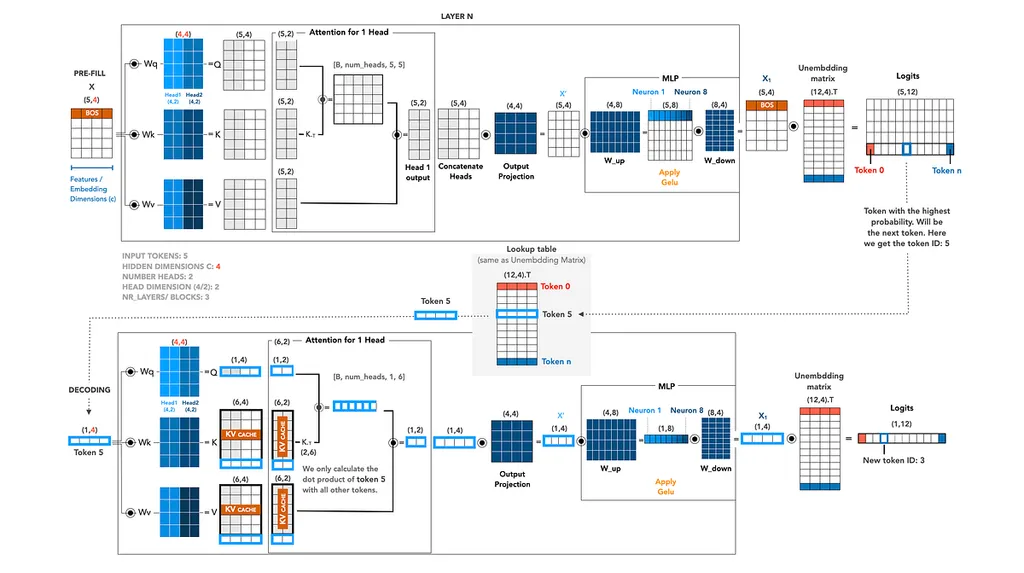
The article discusses the autoregressive next token prediction and the use of KV caches in transformers. It explains how a prompt is processed through a series of transformations to generate the next token in a sequence. The focus is on the mechanics of attention heads and the optimization techniques that enhance the efficiency of long sequence generation.
- ▪Autoregressive language models generate text by predicting the next token based on previous tokens.
- ▪The KV cache is an optimization technique that allows for efficient processing of long sequences in transformers.
- ▪The forward pass involves transforming input tokens into query, key, and value matrices for attention calculations.
Opening excerpt (first ~120 words) tap to expand
Autoregressive next token prediction & KV Cache in transformersFrederik vom Lehn7 min read·1 hour ago--ListenShareUnderstand the optimization technique in LLMs to speed up token generationPress enter or click to view image in full sizeThe general overview (Image by author).The Big PictureBefore we dive into attention heads, KV caches, and the mechanics of generation, it helps to zoom out and see what an autoregressive language model actually is at a glance.A prompt enters as plain text: “How are you?”. A tokenizer chops it into vocabulary IDs — here 3, 7, 1, 9, prefixed with a BOS ("beginning of sequence") token. Each ID is just an integer pointing into a lookup table: a learned matrix of shape (vocab_size, c) where every row is the embedding vector for one token in the vocabulary.
…
Excerpt limited to ~120 words for fair-use compliance. The full article is at Medium.
Discussion
0 commentsMore from Medium