Astronomers weighed a 'little red dot' discovered by the James Webb telescope — and found a 'naked' black hole inside
Astronomers have discovered a black hole within a 'little red dot' identified by the James Webb telescope, which appears to be significantly more massive than its host galaxy. This finding suggests that the black hole may have formed before the galaxy itself developed. The study provides new insights into the formation of supermassive black holes in the early universe.
- ▪The black hole was found in a 'little red dot' known as Abell2744-QSO1, which was discovered in 2023.
- ▪It is estimated to have a mass of around 40 million solar masses, which is unusually high for such a young system.
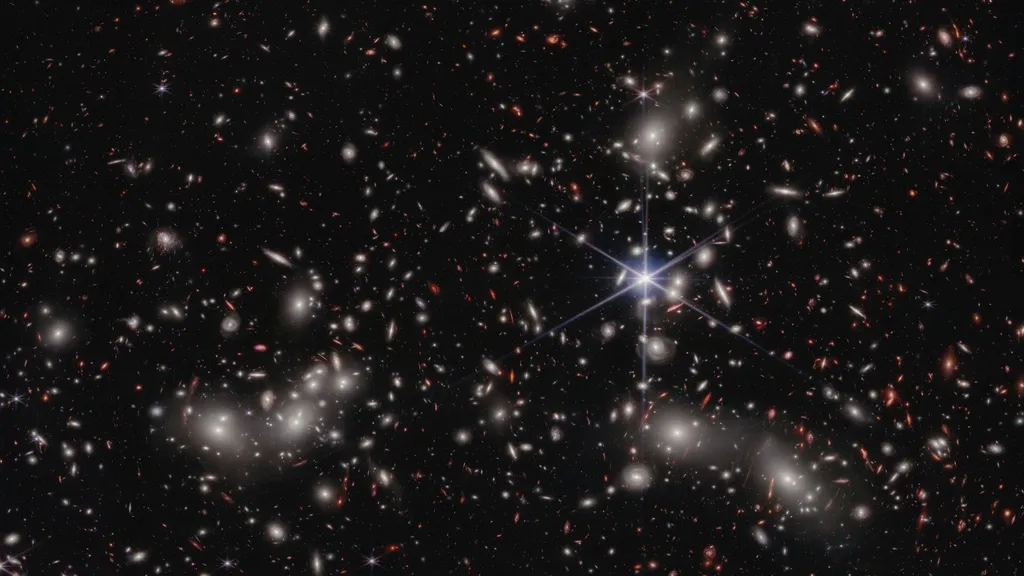
- ▪The galaxy cluster Abell 2744 magnifies the light of QSO1, allowing astronomers to study it more closely.
Opening excerpt (first ~120 words) tap to expand
Space Astronomy Black Holes Astronomers weighed a 'little red dot' discovered by the James Webb telescope — and found a 'naked' black hole inside Astronomers weighed a black hole in a "little red dot" discovered by the James Webb telescope. They found it to be so overmassive that it may have formed before its host galaxy had a chance to develop. By Shreejaya Karantha published 27 May 2026 in News When you purchase through links on our site, we may earn an affiliate commission. Here’s how it works. The galaxy cluster Abell 2744, imaged here by the James Webb Space Telescope, magnifies the light of some of the most distant galaxies and black holes in the known universe. New research uncovers the secrets of one such black hole. (Image credit: NASA, ESA, CSA, I.
…
Excerpt limited to ~120 words for fair-use compliance. The full article is at Live Science.
Discussion
0 commentsMore from Live Science