A Strange Black Hole Mystery Has Stumped Physicists Since 1993. Researchers May Finally Have the Answer
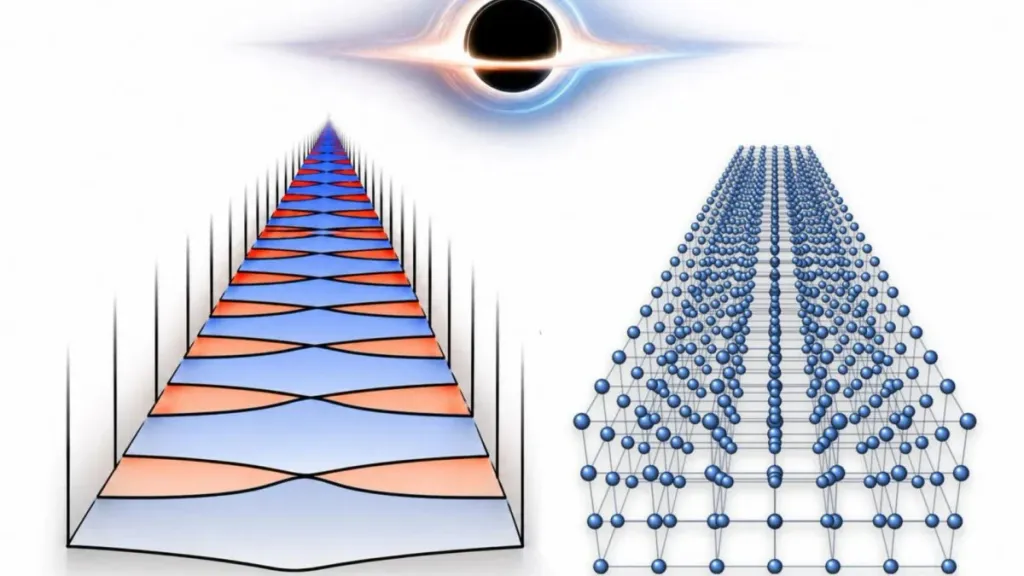
Researchers have made progress in understanding how black holes may emerge from critical collapse, a phenomenon first suggested in 1993. A new theoretical framework provides a formula for how spacetime crystals could collapse into black holes, offering precise parameters for exploration. Further empirical testing is needed to validate these findings and their implications for black hole formation in the early universe.
- ▪In 1993, Matthew Choptuik proposed that black holes could emerge from critical collapse.
- ▪A recent study has provided a formula for how spacetime crystals might collapse into black holes.
- ▪Theoretical results from the study could help astronomers explore black hole formation in the universe's early days.
Opening excerpt (first ~120 words) tap to expand
In 1993, Canadian physicist Matthew Choptuik demonstrated black holes may emerge spontaneously from critical collapse, during which spacetime curvatures organize themselves into a defined, repeating crystal-like pattern. But researchers weren’t quite able to describe this nicely in formulaic language—until now.cnx.cmd.push(function(){cnx({"playerId":"92b7b46b-43ed-4e0e-b21b-2c999302d9d7","settings":{"advertising":{"macros":{"AD_UNIT":"/23178111854/od.gizmodo.com/article","CHILD_UNIT":"article","POST_ID":"2000762518","POST_TYPE":"post","CHANNEL":"science","SECTION":"space","SUBSECTION":"","CATEGORIES":"space","TAGS":"astrophysics,black-holes,general-relativity","NOP":"0"},"timeBeforeFirstAd":0}}}).render("cnx-player-main")}); A team of theoretical physicists say it’s found the long-sought…
Excerpt limited to ~120 words for fair-use compliance. The full article is at Gizmodo.
Discussion
0 commentsMore from Gizmodo