WeSearch

'10,000 times faster than a human scientist' — New AI tool designed ultra-efficient heat-to-electricity generators at lightning speed, a breakthrough that could slash the cost of energy harvesters and help enable cheaper, high-performance home heat pumps
https://www.techradar.com/author/wayne-williams· ·9 min read · 0 reactions · 0 comments · 1 view
#ai#thermoelectric generators#energy harvesting#waste heat recovery#heat pumps
 '10,000 times faster than a human scientist' — New AI tool designed ultra-efficient heat-to-electricity generators at lightning speed, a breakthrough that could slash the cost of energy harvesters and help enable cheaper, high-performance home heat pumps
⚡ TL;DR · AI summary

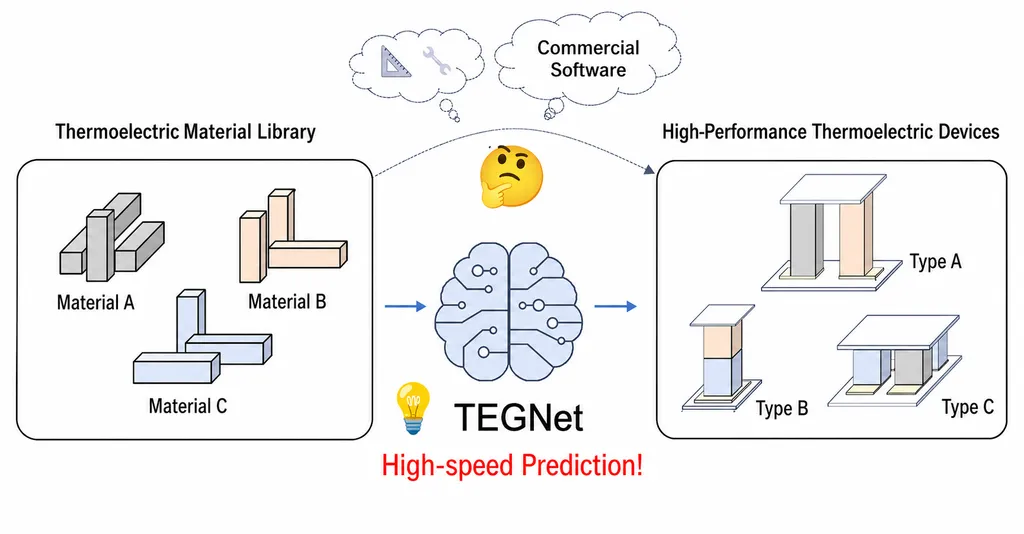
Researchers in Japan have developed an AI tool called TEGNet that designs thermoelectric generators 10,000 times faster than traditional methods while maintaining high accuracy. The tool drastically reduces simulation time from thousands of seconds to fractions of a second, enabling rapid optimization of heat-to-electricity conversion devices. Lab prototypes achieved efficiencies of up to 9.3%, competitive with current standards. This breakthrough could lead to cheaper waste-heat recovery systems and more affordable, high-performance home heat pumps.

Key facts
Original article
TechRadar · https://www.techradar.com/author/wayne-williams
Read full at TechRadar →
Full article excerpt tap to expand

Pro '10,000 times faster than a human scientist' — New AI tool designed ultra-efficient heat-to-electricity generators at lightning speed, a breakthrough that could slash the cost of energy harvesters and help enable cheaper, high-performance home heat pumps News By Wayne Williams published 28 April 2026 TEGNet could help lower the cost of turning waste heat into electricity When you purchase through links on our site, we may earn an affiliate commission. Here’s how it works. (Image credit: National Institute for Materials Science (NIMS)/Future) Copy link Facebook X Whatsapp Reddit Pinterest Flipboard Threads Email Share this article 0 Join the conversation Follow us Add us as a preferred source on Google Newsletter Subscribe to our newsletter AI tool speeds thermoelectric generator design while matching leading prototype performanceTEGNet cuts simulation time from thousands of seconds to fractions of oneCheaper waste-heat harvesters could follow, although manufacturing still has to prove itselfResearchers in Japan have built an AI tool that can design thermoelectric generators far faster than standard simulation methods, pointing to cheaper ways of turning waste heat into electricity.TEGNet was developed by Takao Mori and colleagues at Japan’s National Institute for Materials Science (NIMS) and the University of Tsukuba.In the paper published in Nature, it predicted generator performance with more than 99% accuracy while using only 0.01% of the computing time needed by commercial finite-element solvers.Article continues below You may like Could 'thermodynamic computing' unlock the true possibilities of AI? These studies think so, get ready for better image generation and much more The AI heat trap: why data centers must rethink thermodynamics Microsoft and Nvidia team up to use AI to reduce nuclear project bottlenecks Acting as a fast emulatorThermoelectric generators turn heat differences directly into electricity, with no turbines or moving parts.They already power spacecraft, remote sensors and some isolated infrastructure, but cost and middling performance have kept them out of wider use in factories, refineries, vehicles and electronics.Designing thermoelectric generators is slow because researchers have to balance materials, geometry, temperature conditions, electrical resistance and heat flow.A conventional solver has to solve coupled physics equations again and again, which can take days or weeks for broad searches. window.sliceComponents = window.sliceComponents || {}; externalsScriptLoaded.then(() => { window.reliablePageLoad.then(() => { var componentContainer = document.querySelector("#slice-container-newsletterForm-articleInbodyContent-pXzVpVEbkPhs27WKKSG44n"); if (componentContainer) { var data = {"layout":"inbodyContent","header":"Are you a pro? Subscribe to our newsletter","tagline":"Sign up to the TechRadar Pro newsletter to get all the top news, opinion, features and guidance your business needs to succeed!","formFooterText":"By submitting your information you agree to the <a href=\"https:\/\/futureplc.com\/terms-conditions\/\" target=\"_blank\">Terms & Conditions<\/a> and <a href=\"https:\/\/futureplc.com\/privacy-policy\/\" target=\"_blank\">Privacy Policy<\/a> and are aged 16 or over.","usDisclaimerFooterText":"By signing up, you agree to our <a href=\"https:\\\/\\\/futureplc.com\\\/terms-conditions\\\/\" target=\"_blank\">Terms of services <\/a> and acknowledge that you have read our <a…

This excerpt is published under fair use for community discussion. Read the full article at TechRadar.

Anonymous · no account needed
Share 𝕏 Facebook Reddit LinkedIn Email

Discussion

0 comments

More from TechRadar